Snowflake Integration Guide
Intended audience: Customer DBAs/cloud administrators, platform administrators, implementation consultants Scope: Integration logic and configuration essentials for Snowflake as an Analytics data source Positioning: This document only covers the "data source integration" scenario and does not involve Knowledge vector storage connections
Scope and Version Boundaries
What is supported:
- The platform connects to Snowflake to browse/sync table structures, preview data, and support analytical reporting.
- Supports both password authentication and RSA key-pair authentication.
- Supports specifying key connection parameters such as Warehouse, Role, and Schema in the data source configuration.
What is not supported:
- This document does not cover the configuration and operations of Snowflake as a Knowledge vector store.
- This document does not include advanced integration instructions for Snowflake external OAuth/SSO.
- The platform is not responsible for Snowflake account provisioning, or the creation and authorization of Warehouse/Role; these must be completed by the Snowflake administrator.
Roles and Responsibilities
| Role | Responsibilities |
|---|---|
| ** Snowflake account administrator/DBA** | Create/specify Warehouse, Database, and Schema; create integration users and roles and grant permissions (USAGE/SELECT, etc.); if using key-pair authentication, generate an RSA key pair and bind the public key to the Snowflake user. |
| Platform administrator | Create the Snowflake data source on the platform side, enter connection information, test the connection, and sync metadata. |
| Implementation consultant | Prepare connection information and keys, verify test connection, object discovery, and data preview results, and complete acceptance. |
Prerequisites Checklist
| Category | Prerequisites |
|---|---|
| Permissions | The user must have USAGE on the target Warehouse; USAGE on the target Database/Schema; and SELECT on the tables/views to be synced |
| Account | Snowflake username + password, or Snowflake username + RSA key-pair |
| Network | The platform can access the regional endpoint corresponding to the Snowflake Account (note the difference between .com and .cn regional suffixes) |
| Resource preparation | Account identifier, Database, Warehouse, Role, Schema (default is PUBLIC) |
| ⚠️ Must confirm with DBA | Role permission granularity (whether to use ACCOUNTADMIN or a custom Role), Network Policy/IP allowlist, key rotation policy |
Key Points for Platform-Side Entry
Snowflake Analytics Data Source
| Field Name | Required | Description |
|---|---|---|
| Host | ✅ | Snowflake Account identifier, for example xx20138.cn-northwest-1.aws |
| Database | ✅ | Database name (case-sensitive) |
| Username | ✅ | Snowflake username |
| Warehouse | ✅ | Warehouse name |
| Role | ✅ | Role name, which determines the accessible data scope |
| Schema | Optional | Specify the Schema to access; if left blank, the default permission scope is used |
| Authentication Method | Optional | Password Authentication (default) or Key-Pair Authentication |
| Password | Required for password authentication | Snowflake user password, stored with platform-side RSA encryption |
| Private Key Data | Required for key-pair authentication | RSA private key (PEM format), Base64-encoded and stored encrypted |
| Private Key Password | Optional | Required if the private key is protected with a passphrase |
Entry and authorization process:
- Enter connection information on the data source configuration page (Host, Database, Warehouse, Role, User, Schema).
- Fill in the password or private key related fields according to the authentication method.
- Click "Test Connection" to verify availability.
- After the test passes, click "Save" to complete data source creation.
Detailed Operation Guide
Go to the data source creation page
- Go to the Data > Data Sources page.
- Click New Data Source.
- Select Snowflake as the data source type.
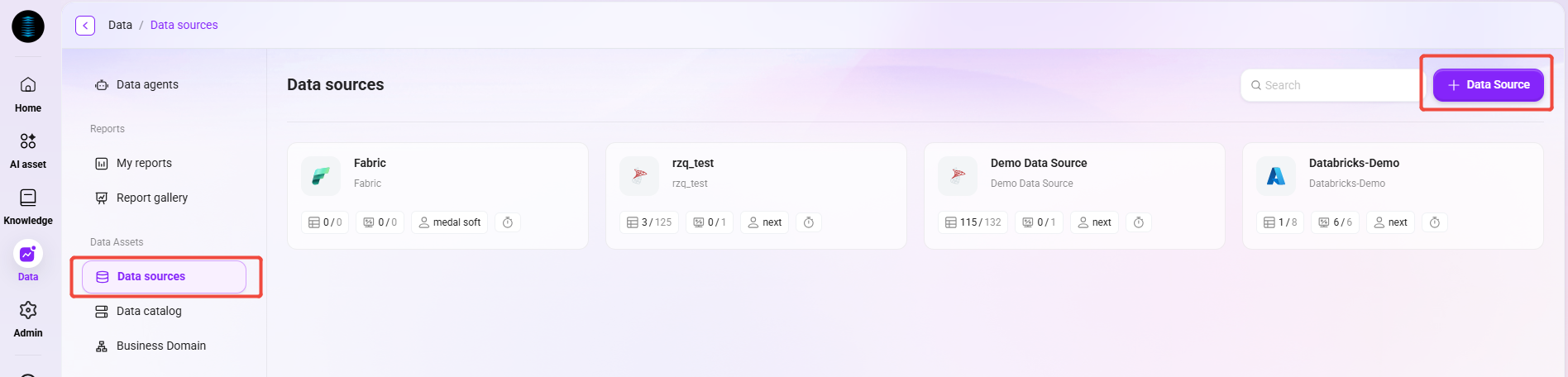
Fill in the basic connection information
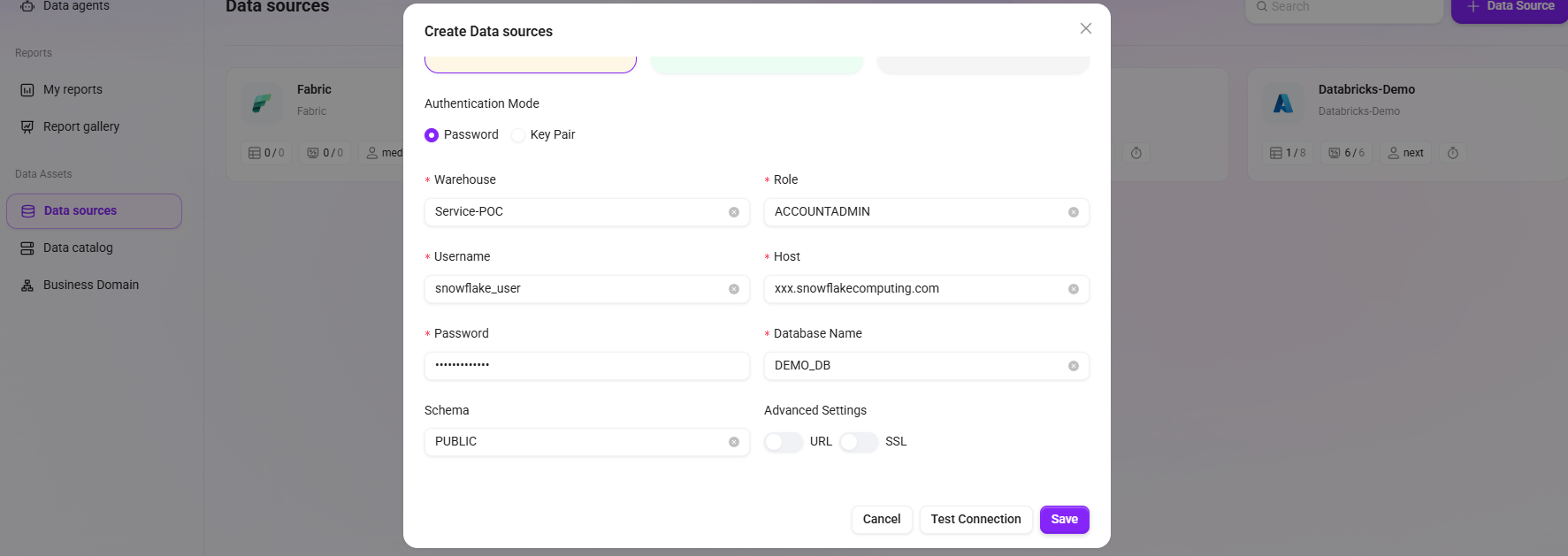
Fill in the following information in the form:
- Host: Snowflake Account identifier (for example
xxx.snowflakecomputing.com) - Database: Target database name (case-sensitive)
- Warehouse: Name of the warehouse used to execute queries
- Role: Role that determines the accessible object scope
- User: Snowflake username
- Schema: Optional; if left blank, the default permission scope applies
Fill in authentication information
Fill in according to the selected authentication method:
- Password Authentication: Enter the user password
- Key-Pair Authentication: Enter
Private Key Data(PEM, Base64) and the optionalPrivate Key Password
Verify the connection
- Confirm that all required fields have been filled in.
- Click Test Connection.
- If the test passes, click Save to complete data source creation.
Common Issues and Troubleshooting Paths
| Issue Category | Symptom | Possible Cause | Troubleshooting Suggestion |
|---|---|---|---|
| Authentication failure | Authentication failure is reported during test connection | Incorrect password; for key-pair authentication, the public key is not correctly bound to the user, or the private key format is incorrect (PEM required, convert to PKCS8 if necessary) | Verify username/password; confirm that ALTER USER ... SET RSA_PUBLIC_KEY has been executed on the Snowflake side and matches the private key |
| Host not found | Reports Host not found | Incorrect Account identifier, or regional suffix mismatch (.com/.cn) | Verify the full Account identifier of the Snowflake account |
| Connection timeout | Test connection times out after a long period of no response | Network policy restrictions, or the Warehouse is suspended and starts slowly | Check the Network Policy/IP allowlist; confirm that the Warehouse can auto-resume normally |
| SSL error | Reports SSL/TLS-related exceptions | Network proxy/certificate interception causes handshake failure | Check whether there is any TLS interception device on the network egress |
| Insufficient permissions | Test connection succeeds but syncing table structures/data preview fails | The user lacks SELECT permission on the target Schema/table | Ask the DBA to grant SELECT on the corresponding tables/views |