File Management
About File Properties
File properties are settings for individual files, while the previously mentioned Knowledge Base Workspace Settings are settings for the knowledge base. The knowledge base workspace settings include file settings, and these settings can be inherited by the file properties.
General Settings
- Basic Information: The basic information in file properties includes file name, size, creator, creation time, modifier, modification time, description, and tags.
💡 Tip: Only files in Org Workspace support using tags, and you can add new tags; files in My Workspace do not support the tag function.
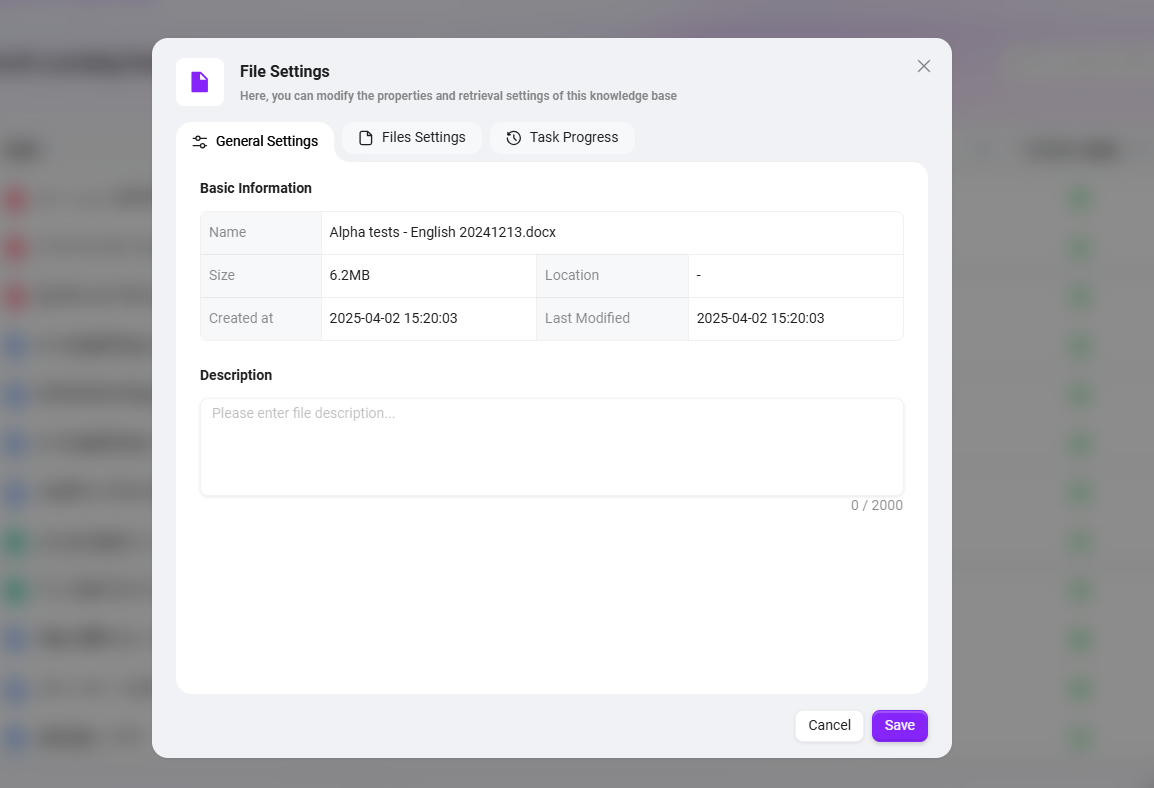
File Settings
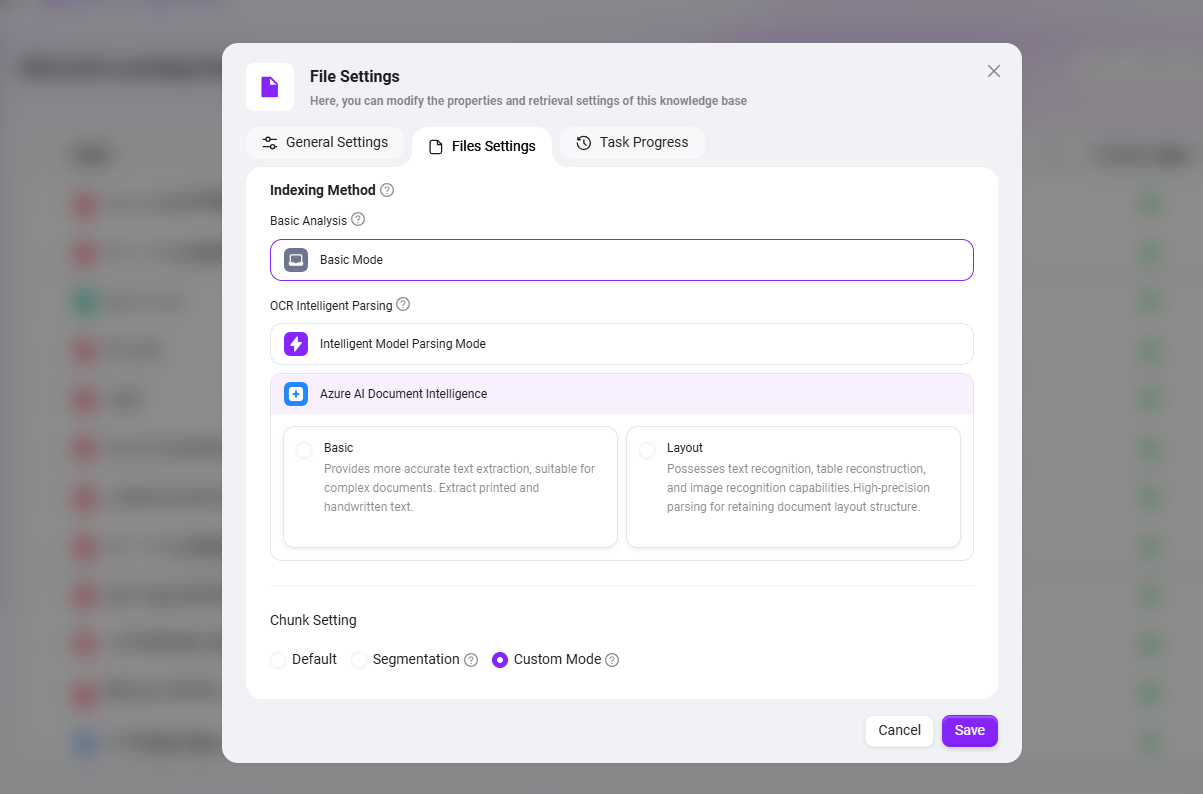
- Workspace Settings: File settings inherit space settings by default; no additional configuration is needed. If a file requires custom settings, turn off the "Inherit Space Settings" button.
- Indexing Method: Basic Analysis, OCR Intelligent Parsing.
- Chunk Setting: Default, Segmentation, Custom.
- Retrieval Settings: File Preview, File Index.
- File Summary Generation: Whether to enable summarization, full-text summary prompt.
💡 Tip: For detailed information on the above file settings, please refer to "How to Configure Knowledge Base Workspace Settings".
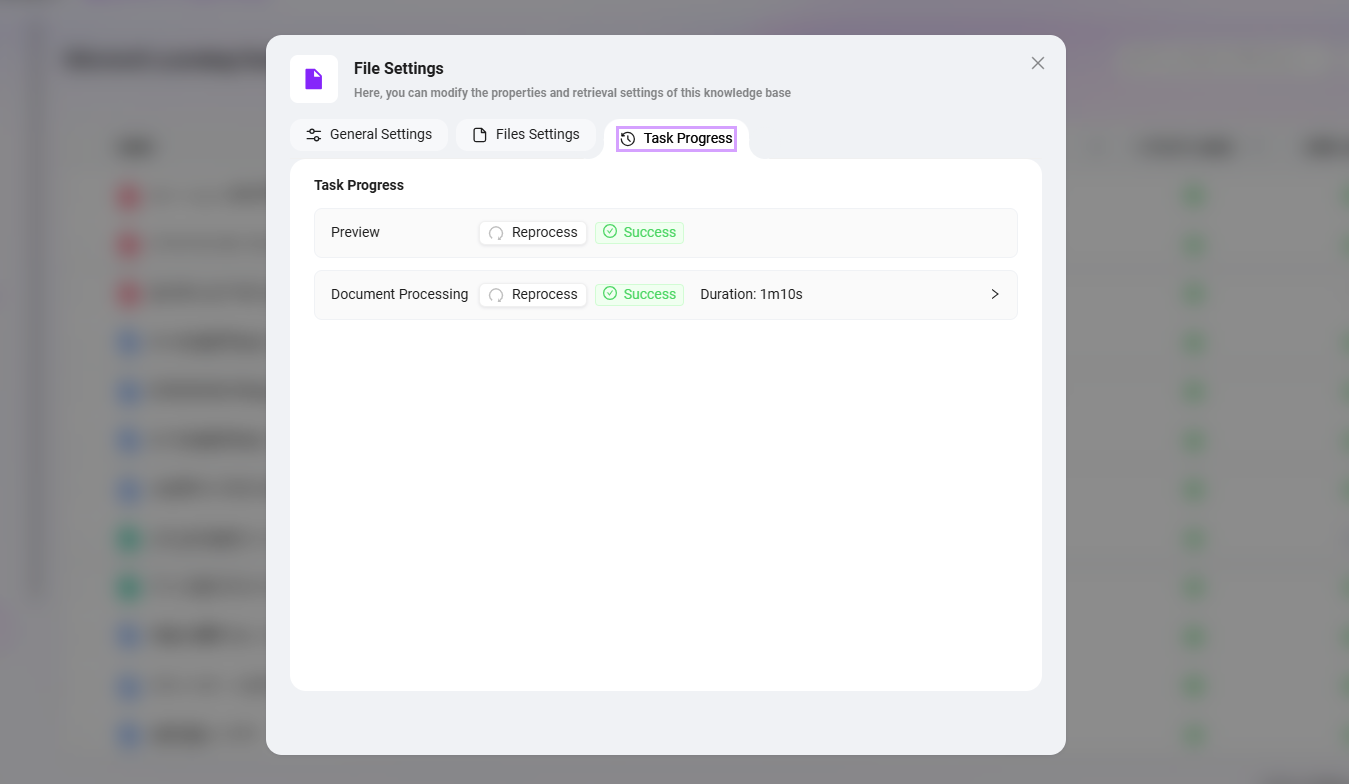
Task Progress
- Preview: Supports file preview. You can view the progress of file preview. If loading fails, click the Retry button to reload.
- Document Processing: File processing involves multiple steps. Click "File Processing" to view the current processing progress and the step it is in.
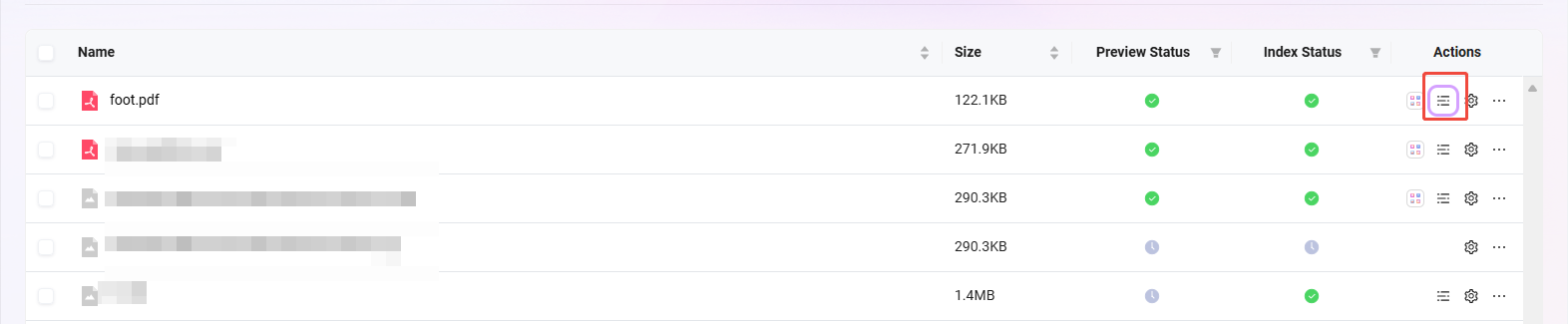
Segment Preview
- Segment Preview supports viewing the segmentation of a file. Each segment has a sequence number and supports editing the segment content.
- Editing segment content does not affect the original file; it only modifies the content used for indexing and preview.
- In the segment preview interface, you can search for keywords to quickly locate the segment where a keyword appears, improving search efficiency.
Explanation of Document Configuration
| Level 1 Module | Level 2 Module | Configuration Item Description | Whether Re-vectorization is Required After Configuration |
|---|---|---|---|
| Segment Preview | Text Editing | Edit and modify text | Takes effect immediately |
| Segment Preview | Text Editing | Bold, italicize text | Takes effect immediately |
| Segment Preview | Text Editing | Add tables, add ordered/unordered lists, insert selected list, insert interactive cards in segments | Takes effect immediately |
| File Properties | General Settings | Add file description | Takes effect immediately |
| File Properties | General Settings | Add tags | Takes effect immediately |
| File Properties | File Settings | Choose whether to inherit space settings | Requires executing "Re-segment" to take effect |
| File Properties | Metadata Management | Add new metadata | Requires executing "Re-segment" to take effect |
| File Properties | Metadata Management | Delete or modify metadata | Does not require re-segmentation; original data is retained |
File Operations
Create New Folder & Upload File
Create New Folder: Both My Workspace and Org Workspace support folder creation. On the knowledge base page, click "New Folder" on the right, enter the folder name, and click "Confirm".

Upload File: To upload files in My Workspace or Org Workspace, click "Upload File" in the upper right corner of the page, select the file(s) to upload, click "Open", and wait for Indexing Successful to use the file.
- File upload has four statuses: Waiting for Indexing, Indexing, Indexing Successful, Indexing Failed.
- Only files with the status "Indexing Successful" can be previewed and used normally.
- Edit permission for the org workspace is required to create new folders or upload files. Please ensure you have the relevant permission before operation.
- Up to 10 files can be uploaded simultaneously, and each file must not exceed 100MB.
- Supports formats: ppt, .pptx, .doc, .docx, .xls, .xlsx, .csv, .md, .txt, .png, .jpeg, .jpg, .pdf, .mp3, .flac, .np4, .xmind, .json, .xml.

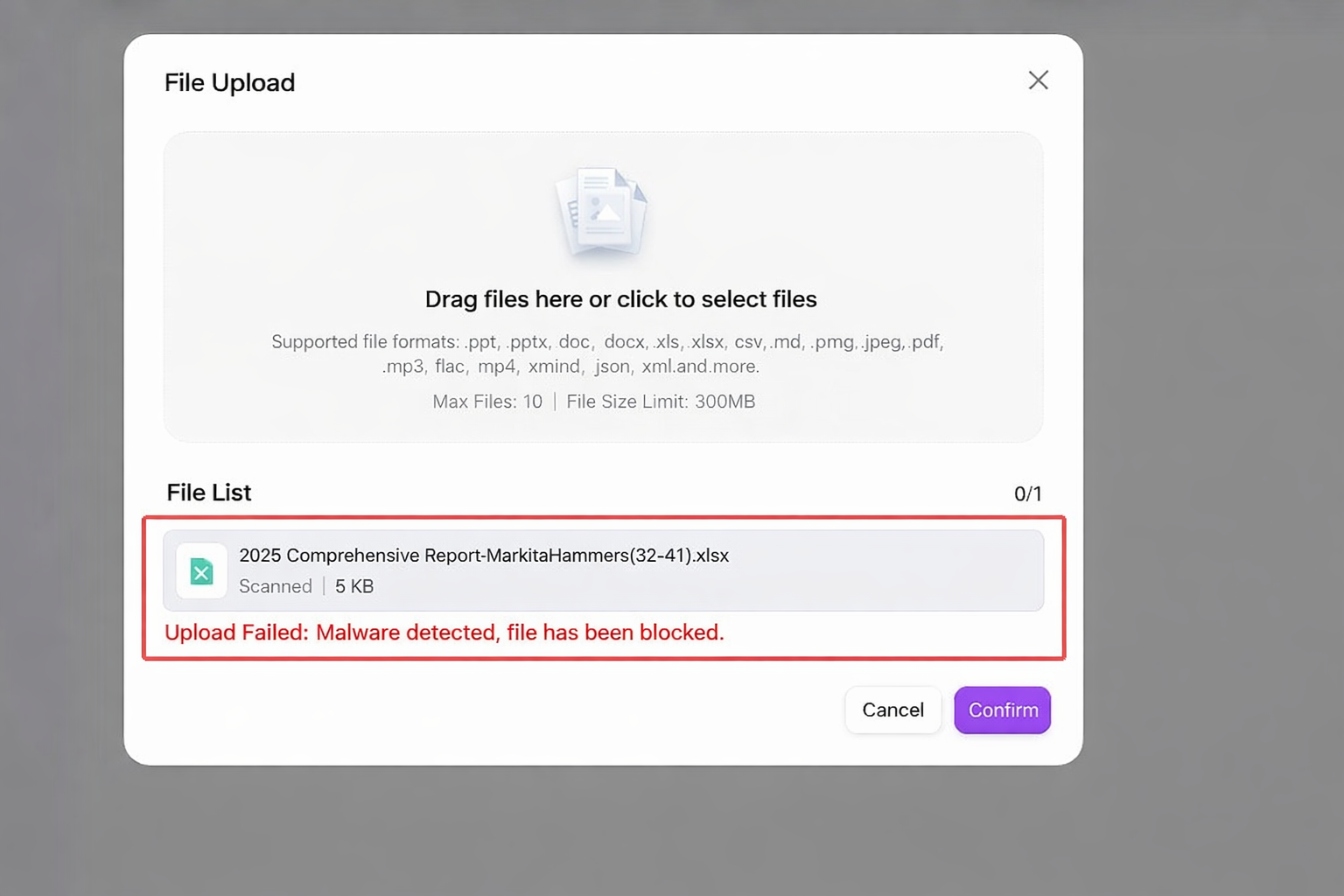
File Upload Security
💡 Tip: This feature is only supported in V4.1.2 and later versions.
To ensure upload security and prevent malicious file uploads, the system integrates file security scanning, which needs to be configured via environment variables.
Move & Copy Files
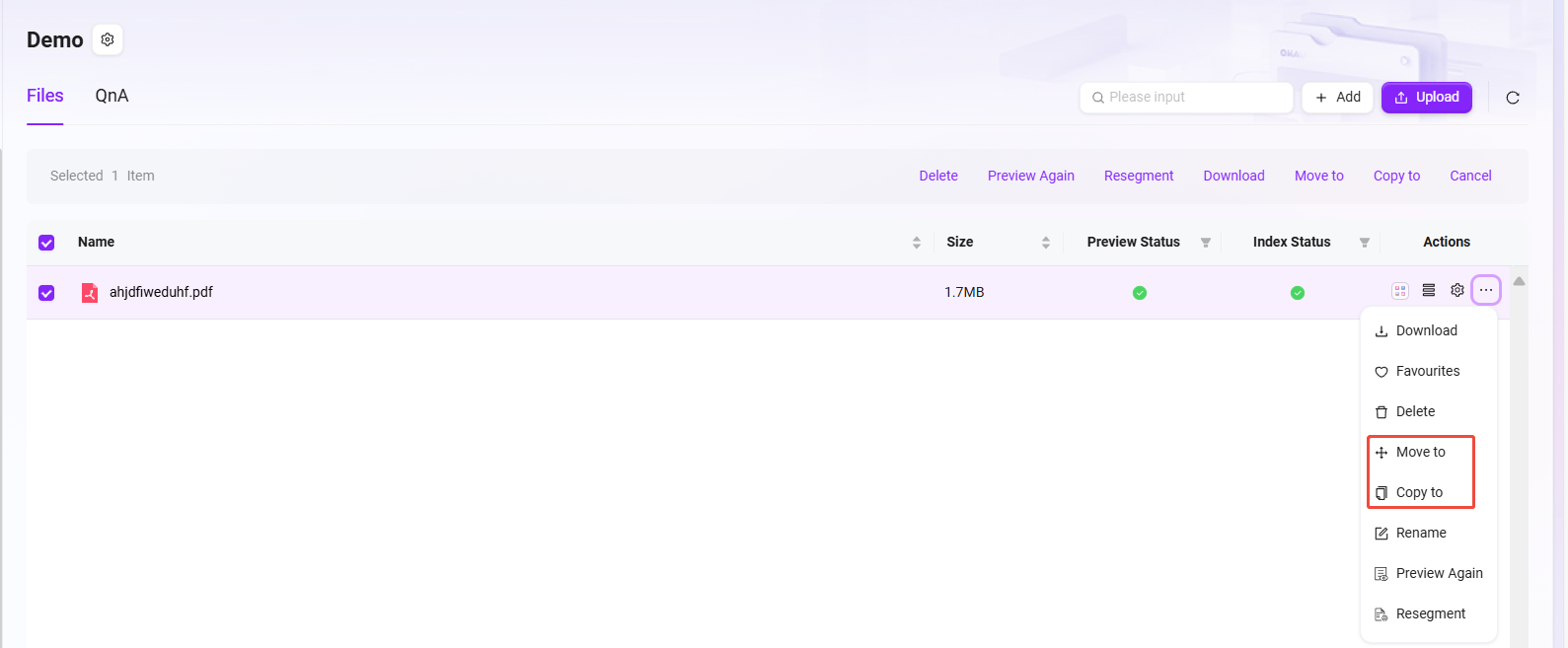
Move/Copy File: Select the file to move or copy, click the "···" on the right, select "Move To"/"Copy To", choose the destination location, and click "Confirm".
- Files in My Workspace do not support moving and copying; only files in Org Workspace support moving and copying.
- Furthermore, moving and copying of files in Org Workspace can only be performed within the same knowledge base.
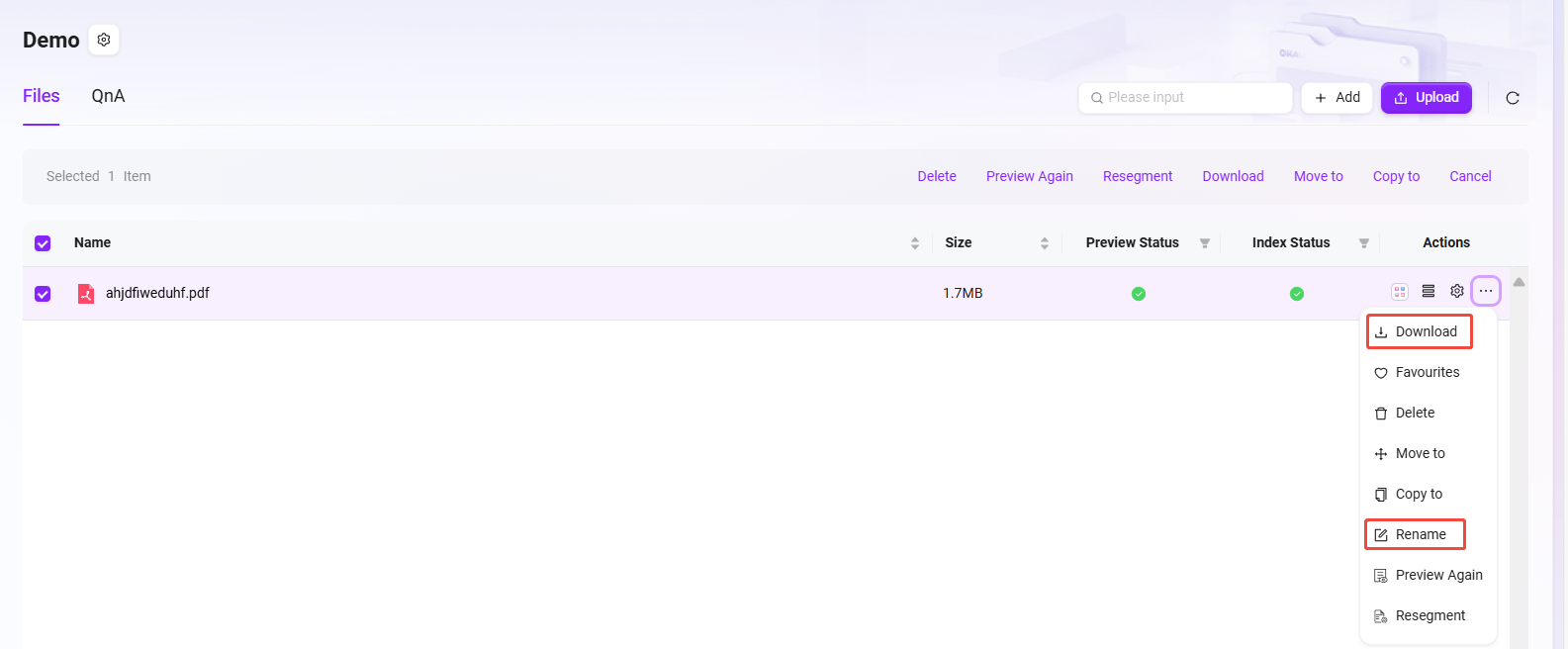
Download & Rename File
- Examples of downloading and renaming:
- Select the file "Azure - Compliance Offerings (September 2024).pdf";
- Click "···" on the right or click "Download"/"Rename" at the bottom of the page;
- Click "Download" to complete the download; click "Rename", enter the new file name, and click "Confirm".
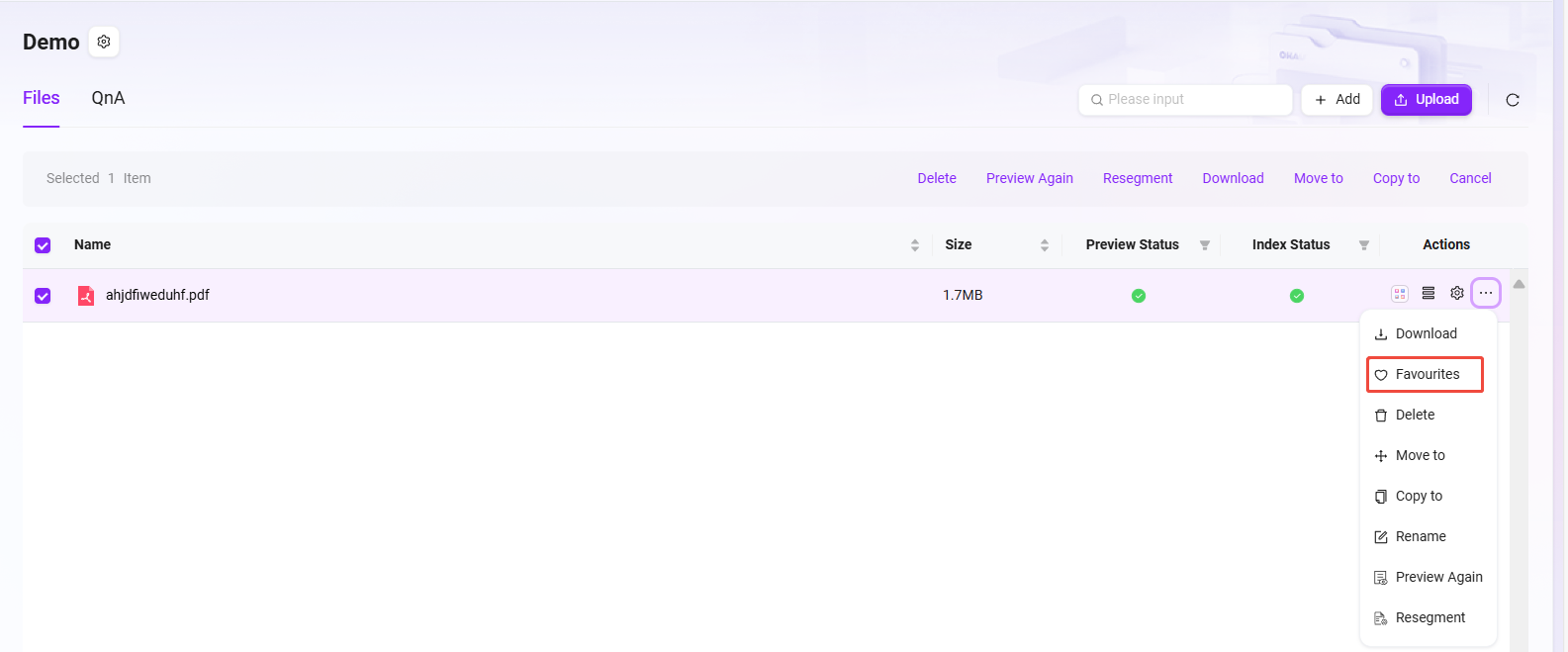
Favorite File
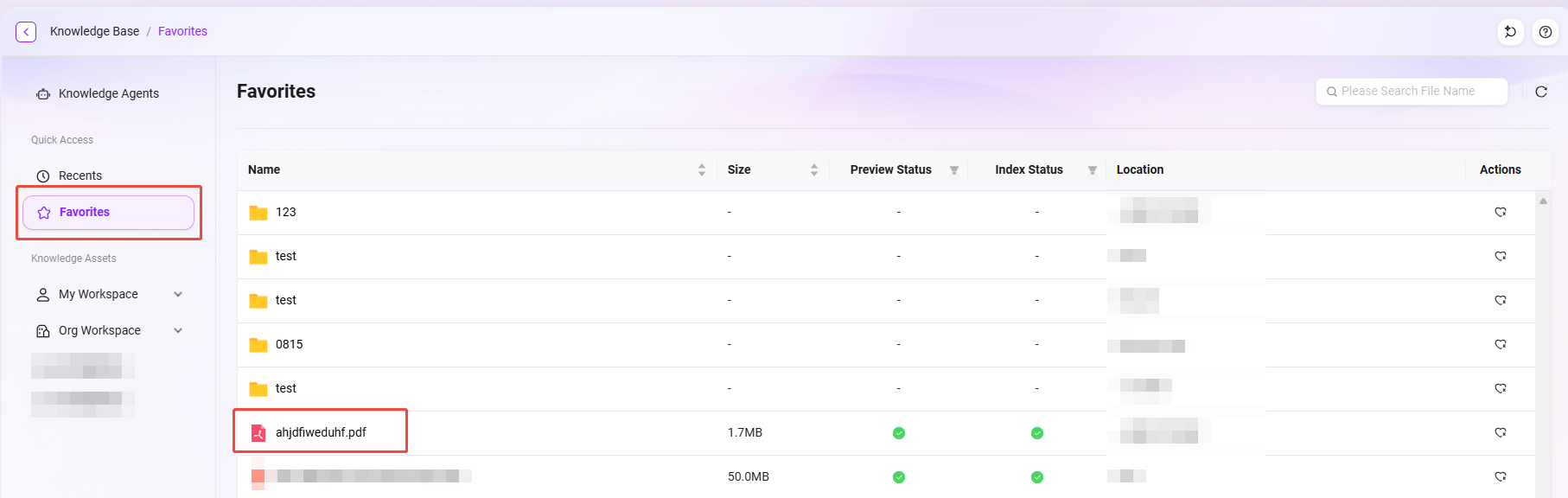
- Example of adding a file to favorites:
- Select the file to favorite;
- Click "···" on the right;
- Select "Favorite". After successful addition, a prompt "Successfully added to favorites" will appear at the top of the page;
- After successful addition, you can remove from favorites in the favorite file list.
💡 Tip: Files in both My Workspace and Org Workspace support favoriting. Favorited files can be viewed under "Knowledge->Favorites".
Favorite File Operation:
File Favorites List:
Preview File
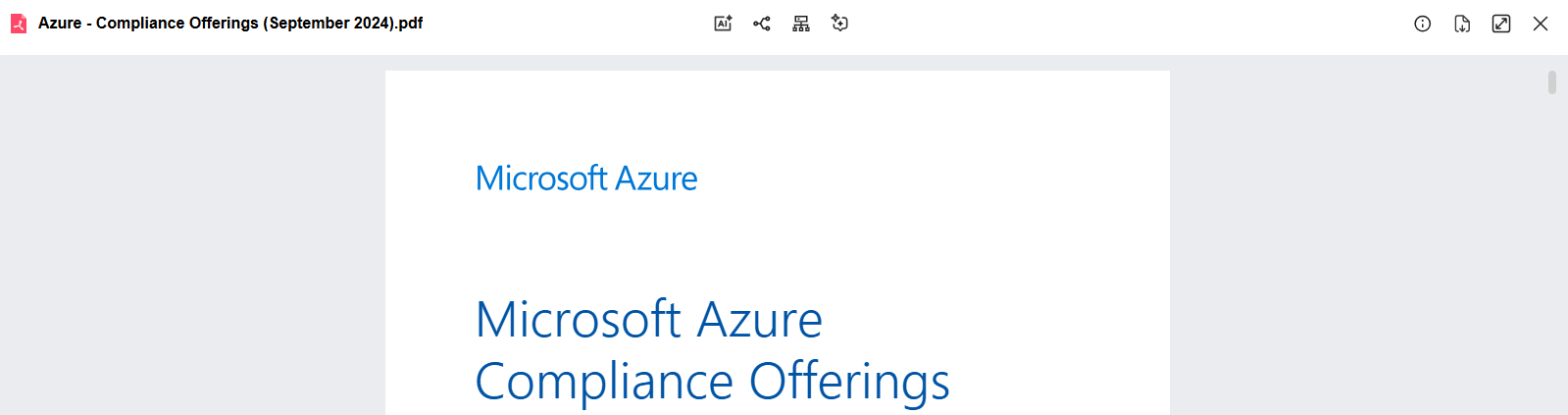
After a file is uploaded and indexed successfully, it goes through a preview process. When the status is Preview Successful, it can be previewed.
The preview page top allows viewing Summary, Mind Map, Outline, Conversation. (AI Summary)
Re-preview & Re-segment
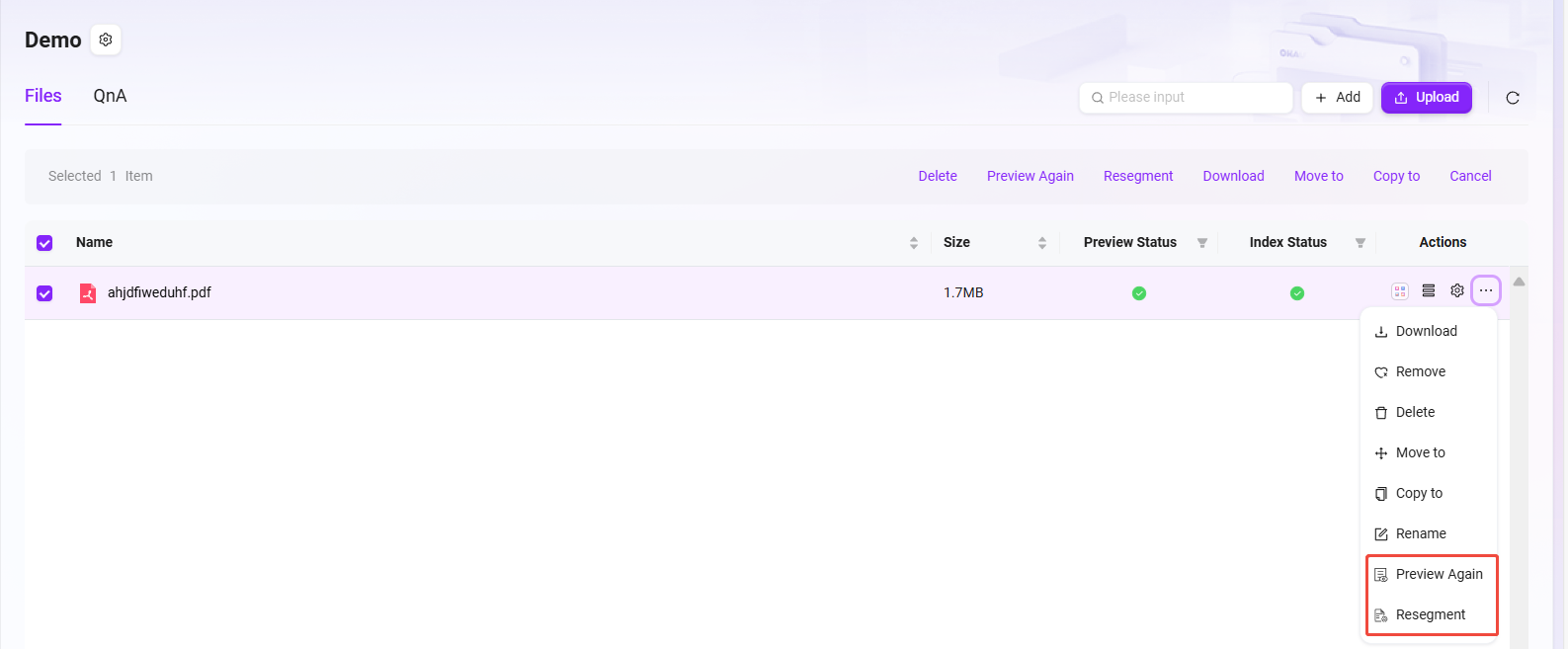
After selecting a file, the "Re-preview" and "Re-segment" buttons will appear.
- Re-preview refreshes the file display to ensure content rendering meets expectations.
- Re-segment adjusts the file structure to make paragraph or segment division more reasonable, optimizing content organization logic.
What is QnA?
Org Workspace has the QnA function. When an assistant retrieves a question from QnA, it will directly provide the preset answer instead of relying on internet Q&A. This effectively avoids issues like inaccurate or inconsistent answers caused by chaotic online information, ensuring reply content precisely aligns with enterprise needs and standards.
QnA supports retrieval based on multiple dimensions such as org workspace, question, and answer, enabling quick location of required information. This greatly improves information search efficiency, facilitating enterprise staff in quickly obtaining accurate knowledge and accelerating business processes.
QnA Related Operations
Import QnA Pairs
QnA has two upload methods. One is Import QnA, which supports batch import, suitable when there are many QnA pairs.
Steps to import QnA:
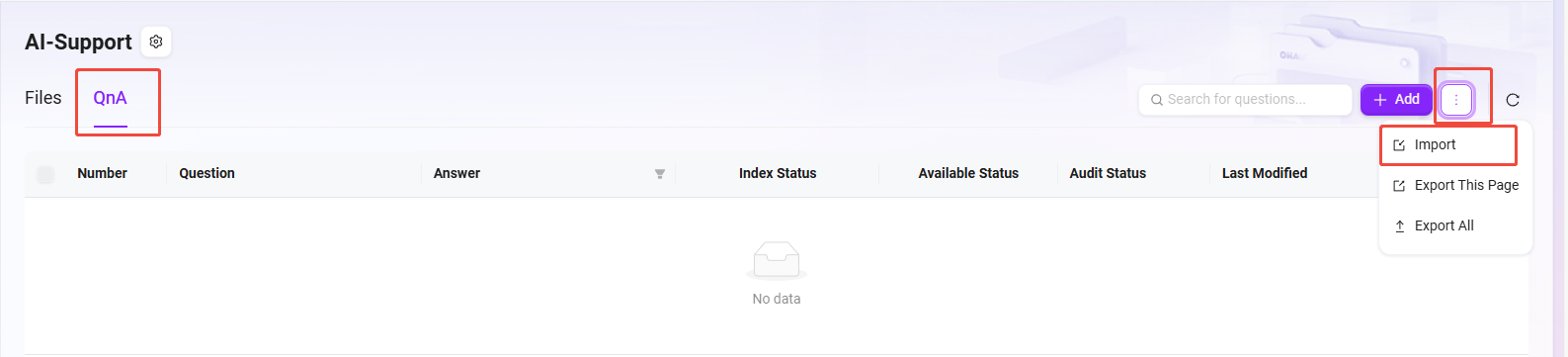
- Enter the org workspace knowledge base and open the QnA interface;
- Click the "···" button on the right and select "Import". The import page pops up;
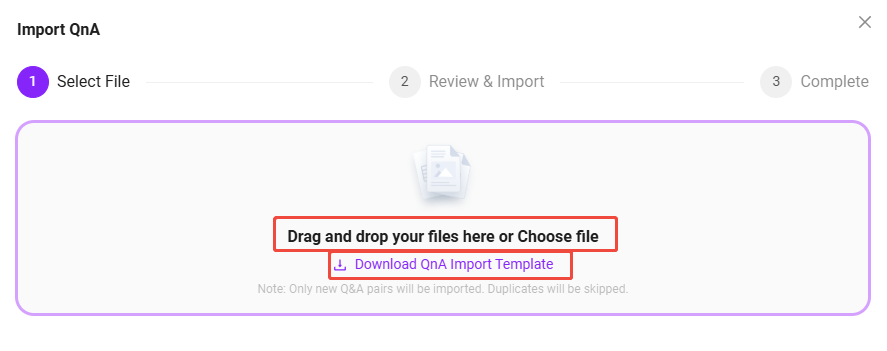
- You can choose to "Download QnA Import Template", fill out the template file. You need to fill in Org Workspace, Question, Answer (Org Workspace refers to the knowledge base name under the org workspace);
- After completing the template file, re-enter the import page following the above steps, drag and drop or select the completed template file;
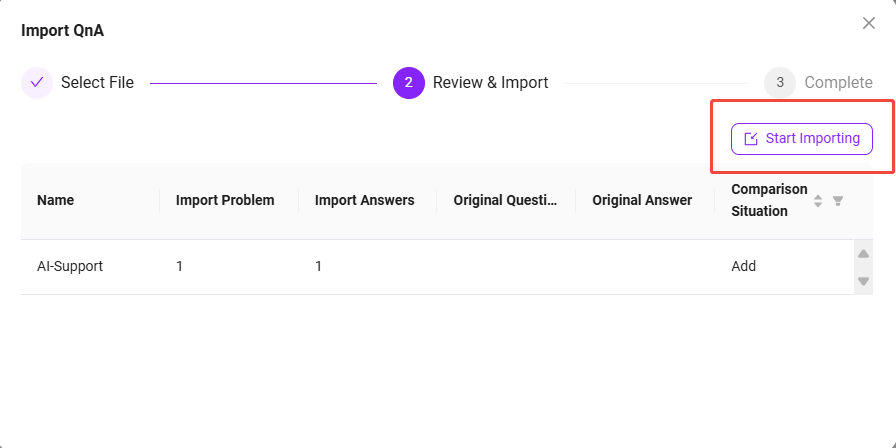
- The file information will be previewed automatically. After confirmation, click "Start Import" on the right;
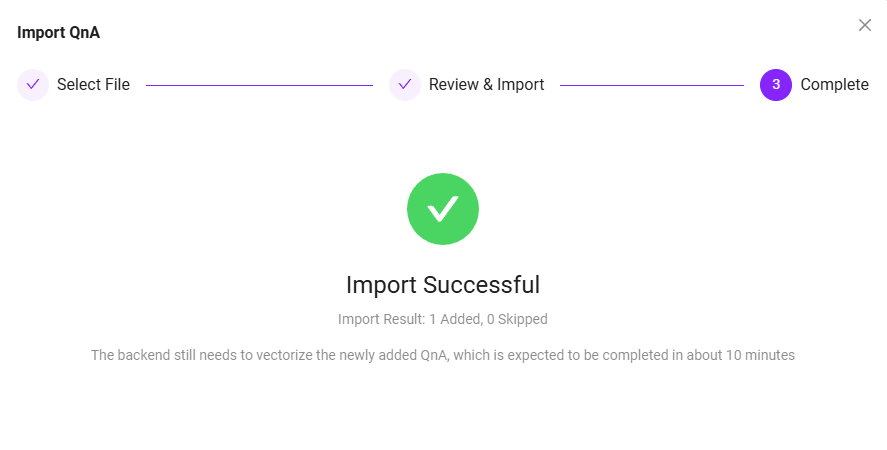
- After waiting, Import Successful will be displayed.
💡 Tip: Only imports new QnA; QnA with questions identical to existing ones will be skipped.

Add New QnA
The other upload method for QnA is Add New QnA, which allows adding only one pair at a time.
Steps to add new QnA:
- Enter the org workspace knowledge base and open the QnA interface;
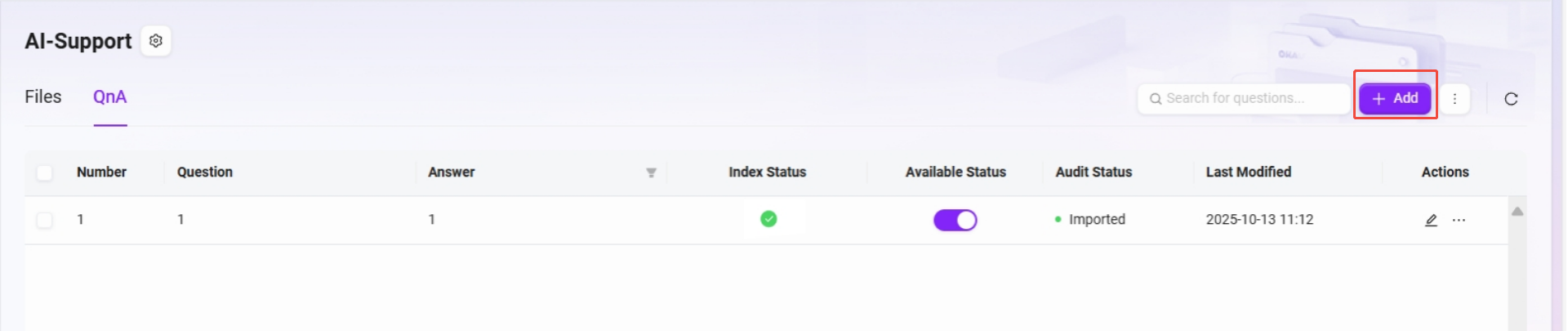
- Click the "Add New" button on the right to enter the addition interface. The left side is the Question interface, and the right side is the Answer interface;
- On the Question side, select the Knowledge Base Name where the QnA belongs;
- Click the "Add New" button to add multiple questions;
- On the Answer side, input the answer. Answer input supports text, links, images, videos, etc.;
- After inputting the answer and questions, click "Save". QnA addition is successful.
💡 Tip: When adding, multiple questions can be added, but all these questions share only one answer, i.e., the answer input on the right side.
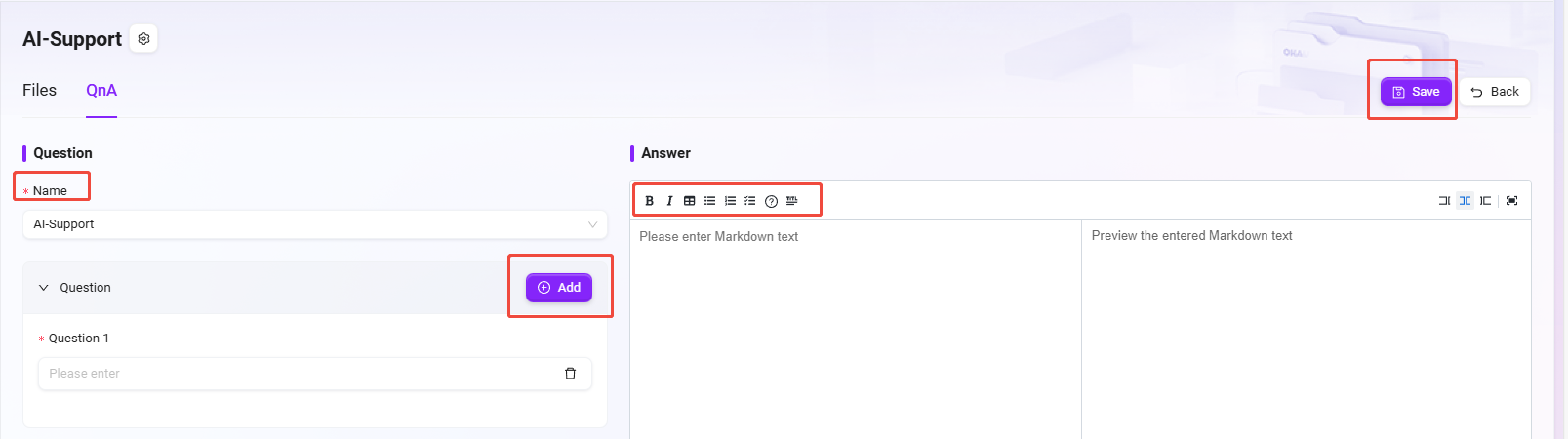
- "Answer" contains rich text style tags. It is recommended to limit the entire answer to within 2000 characters, which will benefit AI replies.
- To insert a video, embed code is required, e.g.,
<iframe src="//player.bilibili.com/player.html?aid=535563667&bvid=BV1jM411S74q&cid=1322473540&p=1" scrolling="no" border="0" frameborder="no" framespacing="0" allowfullscreen="true"> </iframe>.
Review QnA
The QnA review process ensures the accuracy and standardization of knowledge base content. This process mainly targets questions and answers submitted by non-administrators, ensuring content is reviewed by an administrator before entering the QnA library for ordinary users to view. Content submitted by administrators takes effect directly without review. All pending questions are automatically listed at the top for administrators to prioritize.
QnA Review Status: Pending Review, Approved, Rejected
- Pending Review: Submitted questions and answers automatically enter the "Pending Review" status, waiting for administrator review and processing.
- Approved: After administrator review and approval, questions and answers enter the QnA library, accessible to ordinary users.
- Rejected: If content does not meet standards, the administrator can choose to reject. Rejected content is not displayed to ordinary users but is retained in the system for subsequent review.
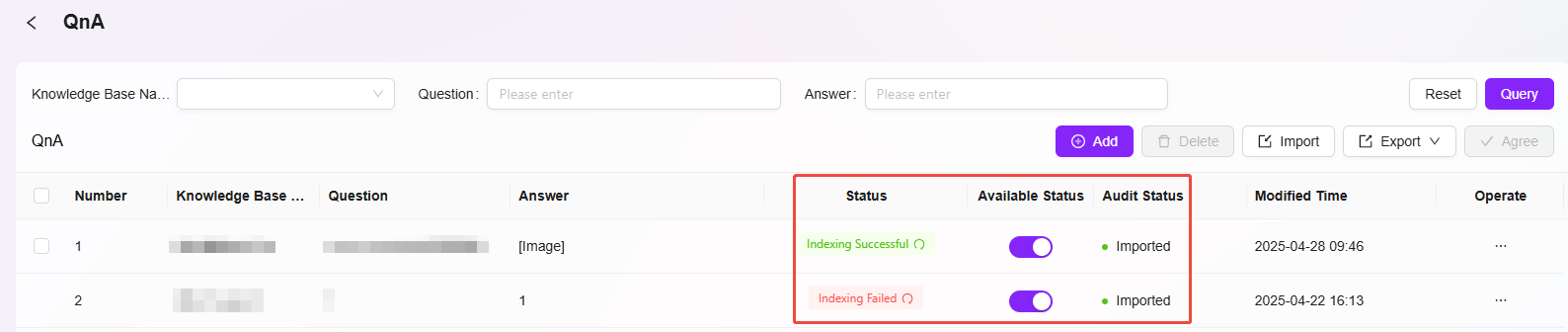
QnA Review Operations: Approve, Reject, Batch Operations
- Approve: The administrator approves content that meets requirements, allowing it to enter the QnA library. Approved QnA cannot be rejected again.
- Reject: For content that does not meet standards, the administrator can choose to reject.
- Batch Operations: Supports administrators selecting multiple pending items for batch approval.

Export QnA
Currently supports exporting QnA. You can Export Current Page or Export All QnA.
Steps to export QnA:
- On the QnA page, click "Export" on the right;
- Select "Export Current Page" or "Export All";
- After export, you can view the file at the local default location.
