Homepage
💡 Tip: This feature is only supported in V4.1.2 and later versions
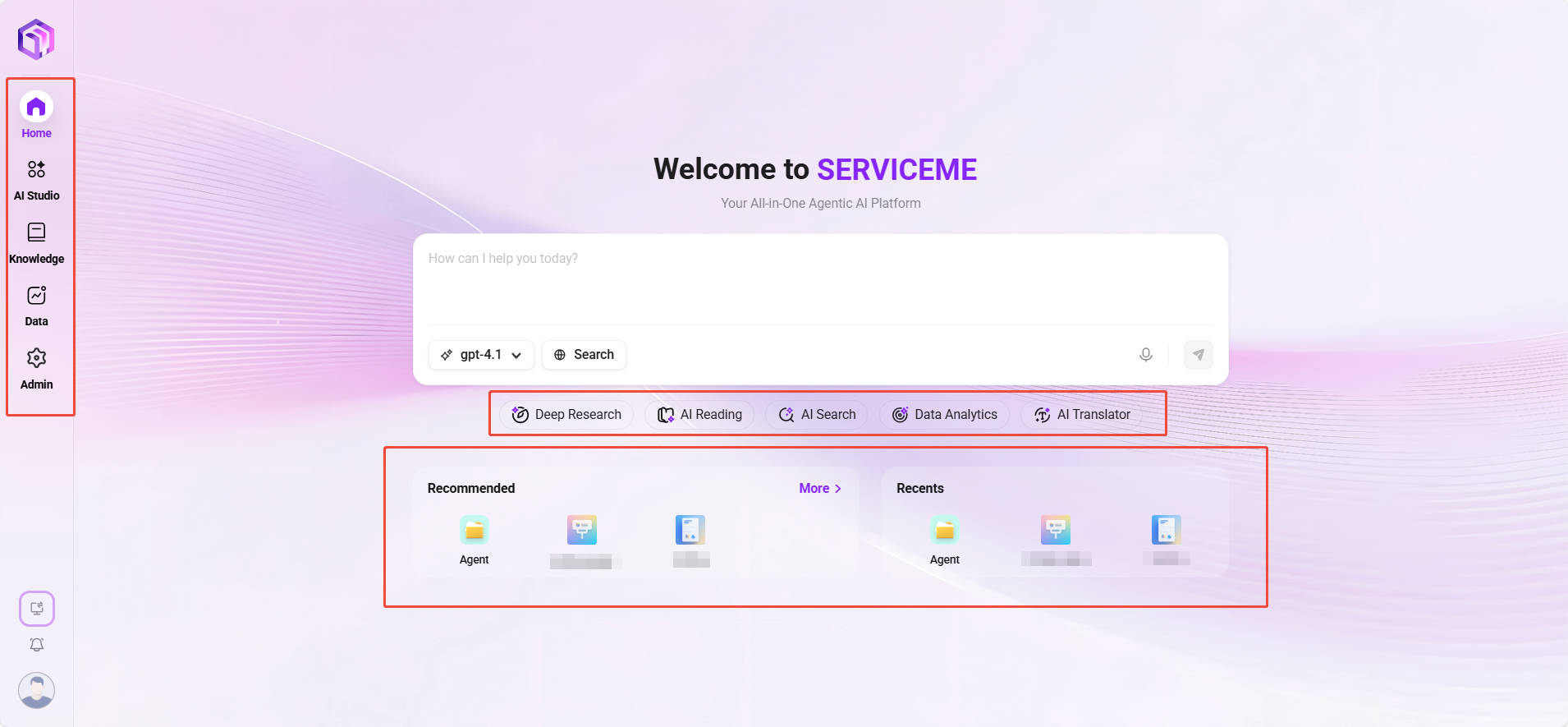
Homepage is the default page users land on after entering the SERVICEME system and is the unified entry point for all features. This page integrates the intelligent conversation area, model selection, quick function entry, and recommended agents area to help users quickly start tasks or enter specific scenarios.
Page Structure
The homepage mainly consists of the following parts:
Intelligent Conversation Area
- Input Box: Users can directly input questions, instructions, or text for natural language interaction.
- Model Selection: Use the dropdown to select the currently used model (e.g., gpt-4.1 or DeepSeek-ai/DeepSeek).
- Conversation Mode:
- "Deep Think" mode: Suitable for complex problems, long logical analysis, strategy generation, etc.
- Different reasoning depth modes can be selected based on business needs to obtain more accurate answers.
- Send Button: Click the paper plane icon in the lower right corner to submit the message.
💡 Tip: The input box supports text, voice, and image input.
Quick Function Entries
Commonly used AI function module entries are provided below the input box, supporting one-click access to corresponding function pages:
Deep Research
Performs topic analysis and report generation.
- Model Support: Supports gpt-4.1, DeepSeek V3, and other non-reasoning models added by users.
- Research Directions: Covers news, popular science knowledge, and academic fields.
- Research Configuration:
- Maximum research attempts per round: 1–30 times.
- Maximum subtopics per topic: 1–30.
- Report Style Setting:
- Style Name: Within 50 characters.
- Role Setting: Within 2000 characters.
- Style Description: Within 2000 characters.
AI Reading
Upload documents and generate summaries or comprehension.
⚠️ Note: Starting from V4.1.2, the original "AI Summary", "Mind Map" and other functions have been fully integrated into the AI Reading module, forming a unified document processing experience. Further enhancements will be made on this basis, and more capabilities such as document translation and screenshot questioning will be gradually incorporated in the future.
- File Size: Not exceeding 100MB.
- File Formats: .ppt, .pptx, .doc, .docx, .xls, .xlsx, .csv, .md, .txt, .png, .jpeg, .jpg, .pdf, .mp3, .flac, .mp4.
- Upload Count: Supports only 1 file per upload.
- Upload Method: Supports knowledge base call or local upload.
AI Search
Based on semantic understanding, performs intelligent cross-source retrieval in your knowledge base and the internet.
- Two Modes
- Quick Search: Fast response, suitable for scenarios requiring immediate answers.
- AI Search: Results are more in-depth and relevant, with intelligent integration and refinement of information.
- Search Content: File name, file content, QnA questions, QnA answers.
- Search Result Display: All, Documents, QnA, Web.
- Supported Languages: Chinese, Traditional Chinese, English (other languages can be added in multilingual settings).
Data Analysis
Supports users analyzing structured data of selected business domains using natural language. The system automatically generates SQL queries and visual charts.
- Structured Data Analysis: Supports connecting and processing standardized business data tables for in-depth mining.
- Analysis Scope: Covers all data assets within your business domain, including but not limited to business indicators, statistical reports, data dashboards, and other structured data.
- Note: The understanding, analysis, and SQL generation of queries are mainly accomplished through AI technology. You can improve query result accuracy and applicability by optimizing question expression or adjusting metadata configuration in the data catalog and business domain modules.
AI Translation
Quickly implements multilingual document and sentence-level translation.
- Document Format: Only PDF format documents are supported.
- Upload Method: Supports selection from knowledge base or uploading local documents.
- File Size: Not exceeding 20MB.
- Processing Method: Processes 1 file at a time, supports up to 100 document uploads in total.
- Supported Languages: English, Simplified Chinese, Traditional Chinese, Japanese, Korean, French, German, Spanish, Italian, Portuguese, Russian.
Recommended Agents
- Recommended Agents: The system recommends agents based on usage frequency and role characteristics (e.g., File Copilot, Copilot, QA|Anakin, etc.).
- More Button: Click "More" to view all available agents.
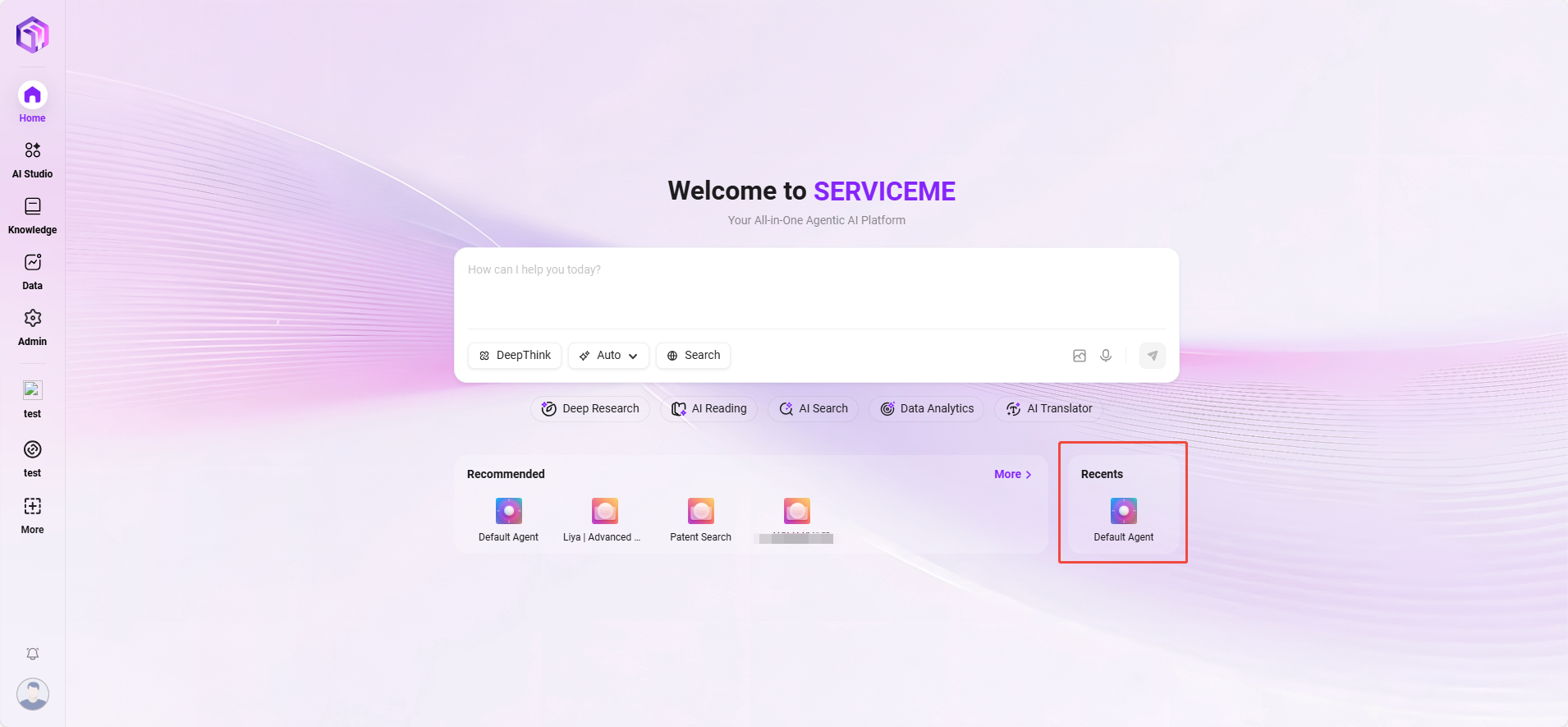
Recent Use
- Displays agents or tasks recently used by the user, supporting quick return to the last work scenario.
Usage Suggestions
- It is recommended that users first select an appropriate model and mode after initial login to ensure task results meet expectations.
- It is recommended to pin frequently used agents on the homepage for quick daily access.
- If the homepage fails to load or agents are not displayed, please confirm network environment and License status.
Example Operation
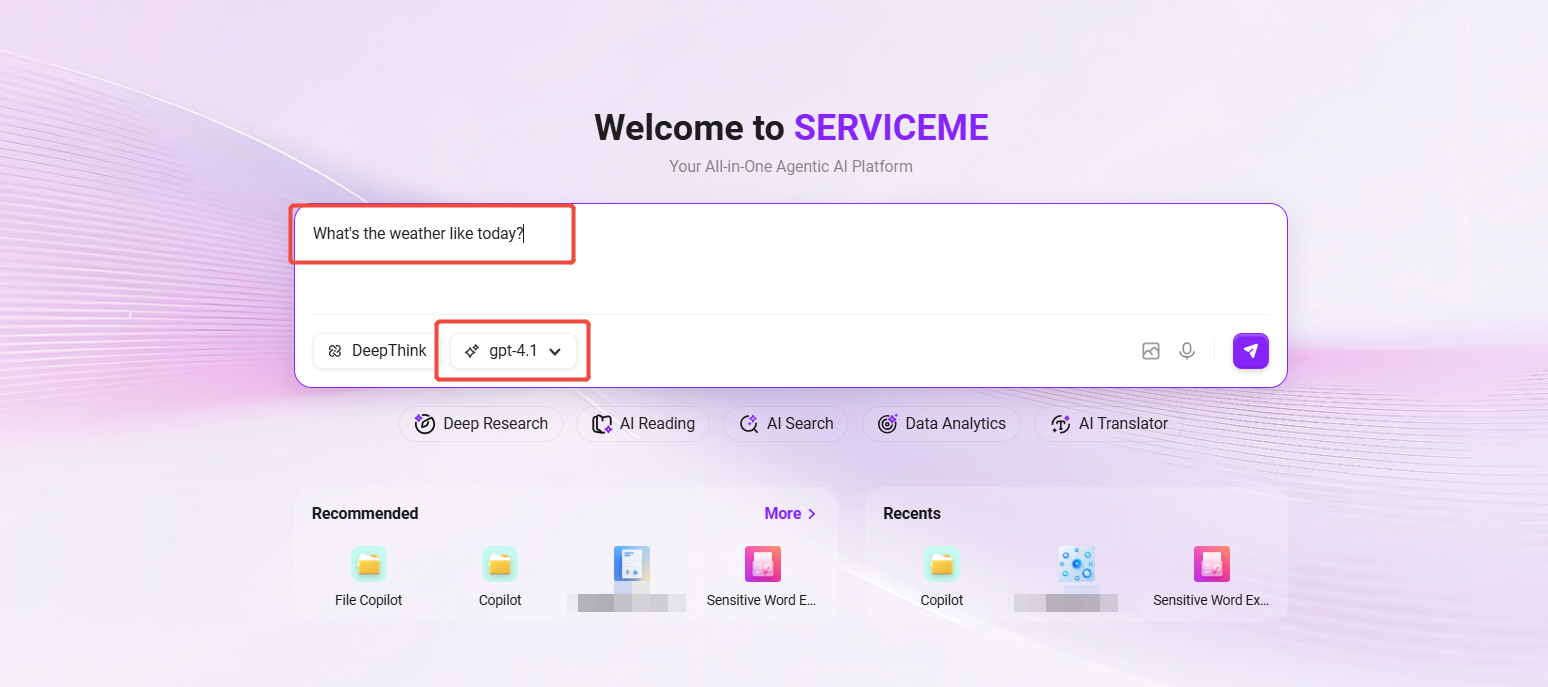
- Enter an instruction in the input box, such as "What's the weather like today?".
- Select a model (e.g., gpt-4.1).
- Click "Send" or press Enter.
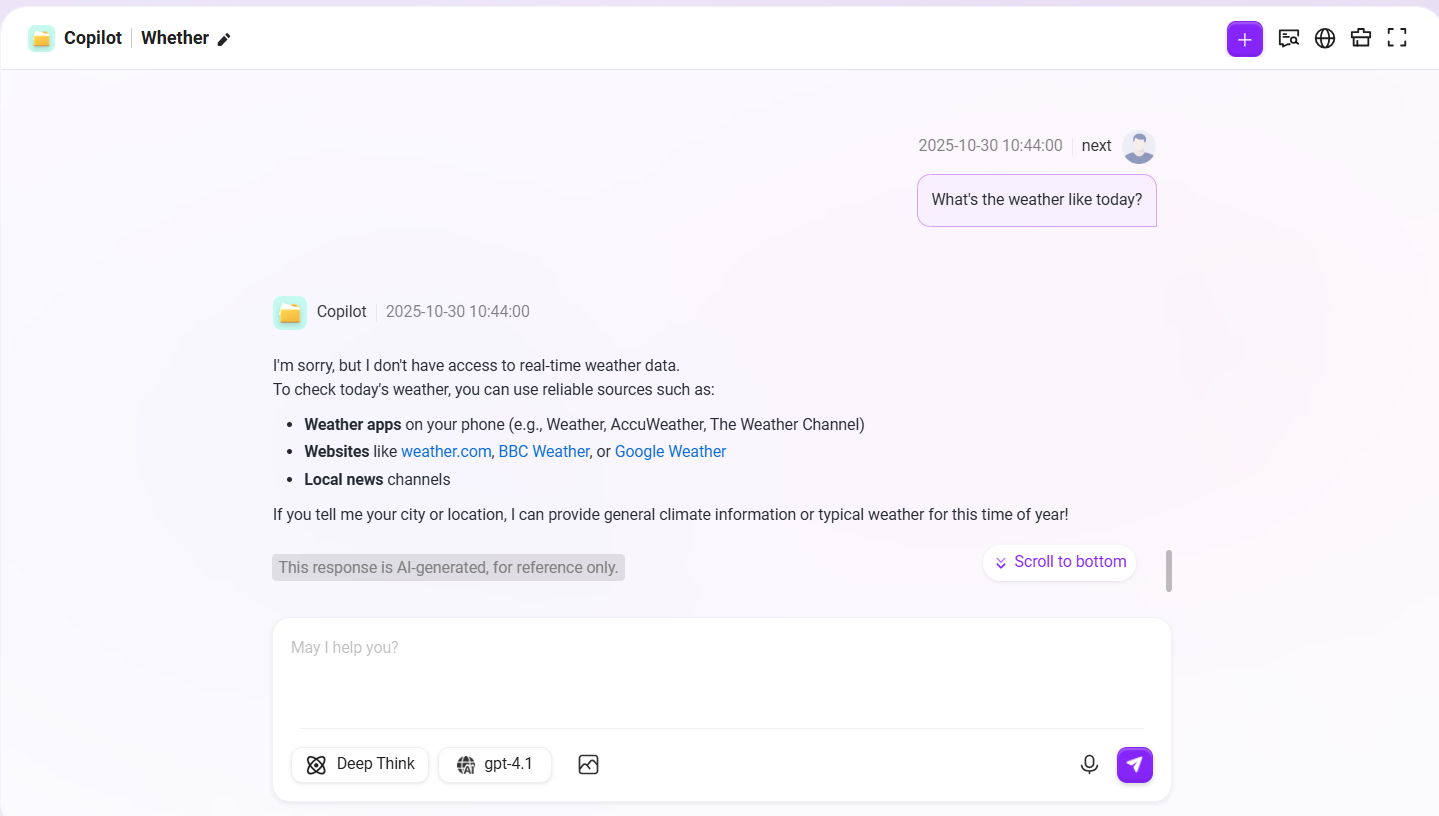
- The system will automatically call the corresponding model and return the result.
Homepage Customization
To optimize the user experience for different user groups and lower the entry barrier, the system provides two interface styles: "Simple Mode" and "Traditional Mode". Users can select and switch between them based on their roles and operating habits.
Design Goal: "Simple Mode" provides a more focused and concise interface through customizable homepage modules and sidebar, significantly reducing the learning curve for new users.
Mode Introduction
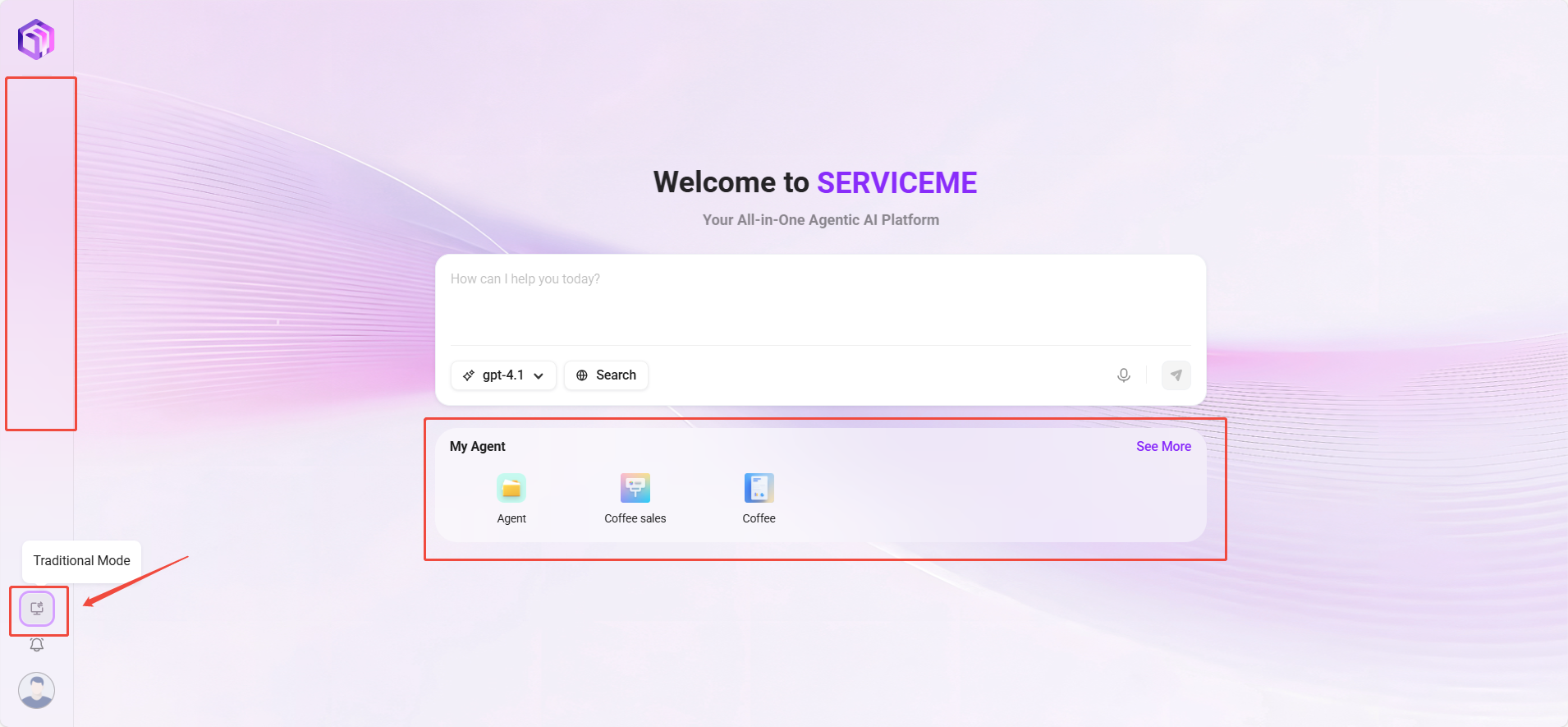
- Simple Mode: The interface is extremely simplified, retaining only the homepage's core functional area and hiding the left navigation bar. This mode focuses on intelligent conversation and the most commonly used quick entries, suitable for business users seeking out-of-the-box experience without complex navigation.
- Traditional Mode: Provides the complete system interface, including the left navigation bar and all function module entries, offering a full-fledged workbench for technical or advanced users who need access to and management of various functions.
Mode Setting Rules
-
Default Mode for New Users
- The system administrator can set the default value (
simpleortraditional) in the backend environment variablePUBLIC_DEFAULT_UI_MODE. - When a user logs in for the first time and has no switching record, they will automatically enter the mode set by this configuration.
- The system administrator can set the default value (
-
User Manual Switching and Memory
- Users can manually switch between the two modes at any time.
- Core Principle: Once a user manually switches the mode, the system will remember this choice. Subsequent logins will directly enter the mode last used by the user, no longer affected by the environment variable.
How to Switch Modes?
Users can switch between the two modes at any time via the navigation bar button at the bottom left of the page.
Simple Mode:
Traditional Mode: