Using Skills
Built-in Skills
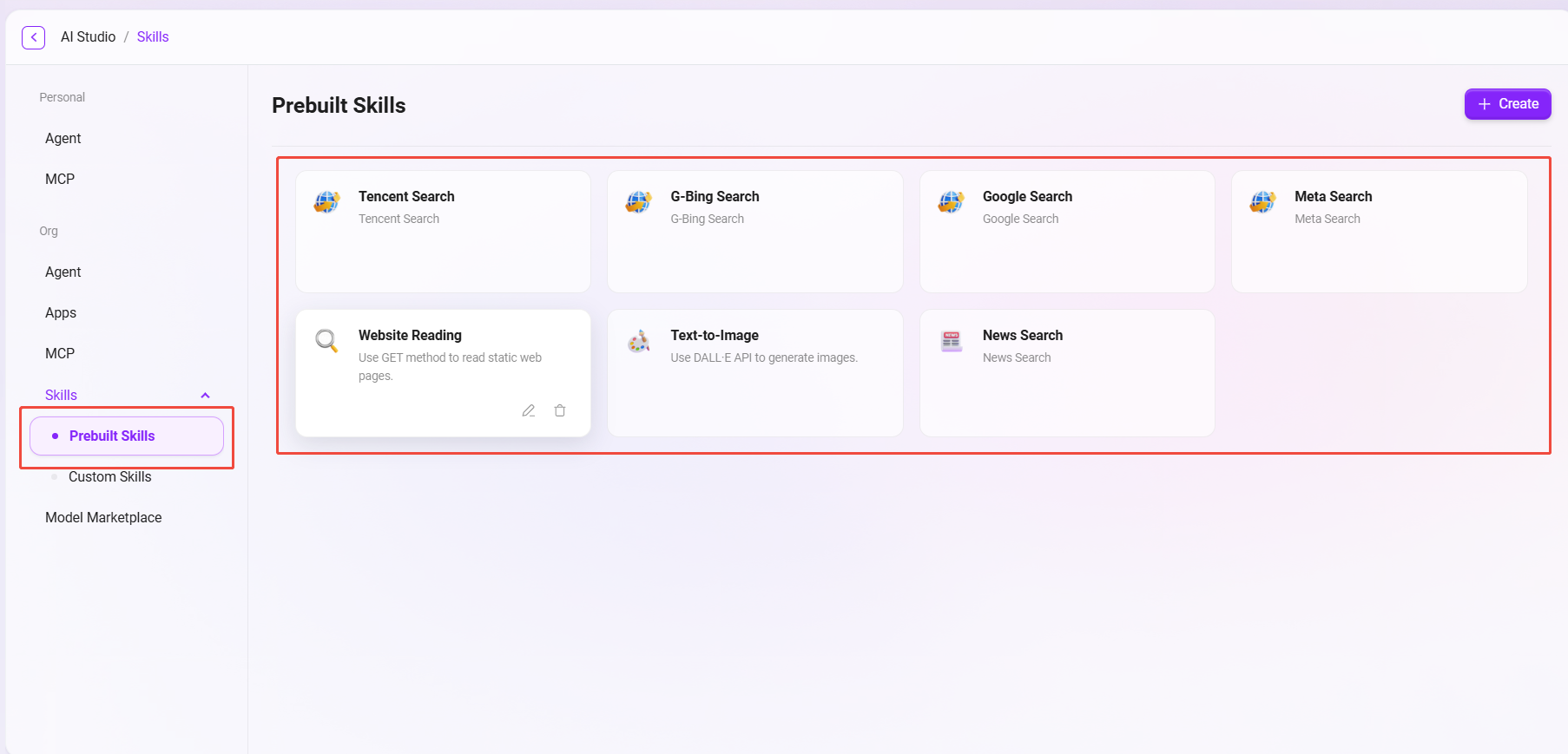
Built-in skills are functional modules pre-developed and integrated into the system, designed to provide users with fast and convenient automation services. These skills can be used directly in assistant configuration without requiring any additional development or setup by the user.
Available Built-in Skills
-
Google Search: Provides real-time, extensive information from the internet.
-
Tencent Search: Offers web information retrieval capabilities based on Tencent's search service, suitable for precise searches of Chinese content.
-
Alibaba Cloud Search: A one-stop enterprise-grade intelligent search service that integrates proprietary search engines with large language models, enabling rapid development of semantic retrieval, RAG-based question answering, and multimodal search capabilities.
💡 Note: This feature is only supported in version V4.1.3 and above.
-
Meta Search: Delivers efficient and precise search services, quickly locating and returning the information users need. Ideal for scenarios requiring rapid information verification, data lookup, or obtaining concise answers in daily queries.
-
Webpage Reading: With this skill, users can specify a URL, and the system will automatically read the content of that webpage. This feature is particularly useful for users who need to extract information from web pages, such as obtaining data from news sites, blogs, or any public web page.
-
Text-to-Image: This skill uses the DALL-E interface to generate images. Users can input descriptive text, and the system will generate corresponding images based on these descriptions. This skill is suitable for scenarios requiring visual content generation, such as design, artistic creation, and educational purposes.
-
News Query Tool: This skill allows users to query the latest news information. Users can quickly obtain news reports on specific topics or keywords through simple commands, helping them stay informed about current hot events and information trends.
Advantages of Built-in Skills
- Convenience: Users can use these skills directly without additional development or configuration.
- Diversity: Covers a variety of functions including news queries, webpage content extraction, image generation, and online search to meet different needs.
- Efficiency: Through integrated automation services, users can complete tasks and obtain information more efficiently.
Custom Skills
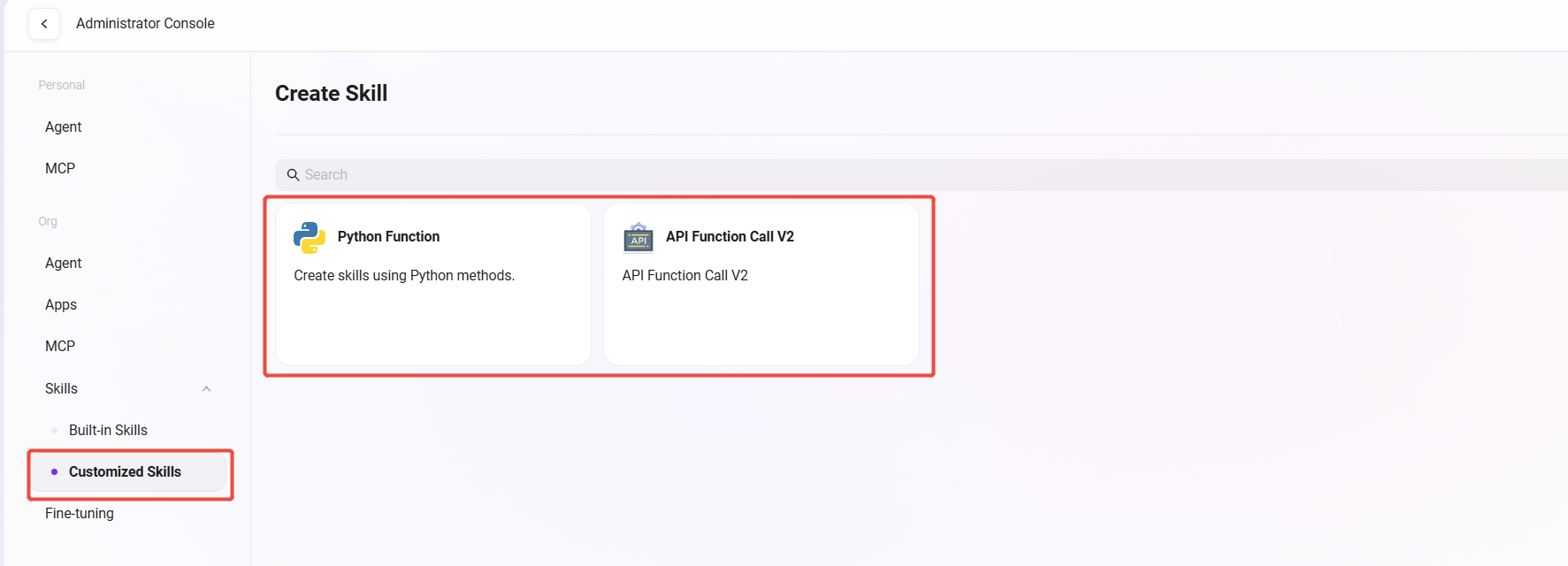
Custom skills refer to skills developed or configured by users according to their specific needs and business scenarios. These skills can extend the assistant's functionality, making it more tailored to users' personalized requirements.
Advantages of Custom Skills
- Flexibility: Users can customize skills based on their own needs to enhance the assistant's capabilities.
- Adaptability: Two creation methods, Python and API, meet the needs of different users, from simple to complex scenarios.
- Scalability: Custom skills can be extended with more features through programming, making the system better suited to business processes and scenario requirements.
How to Use Skills
Configuring Skills in Basic Agent
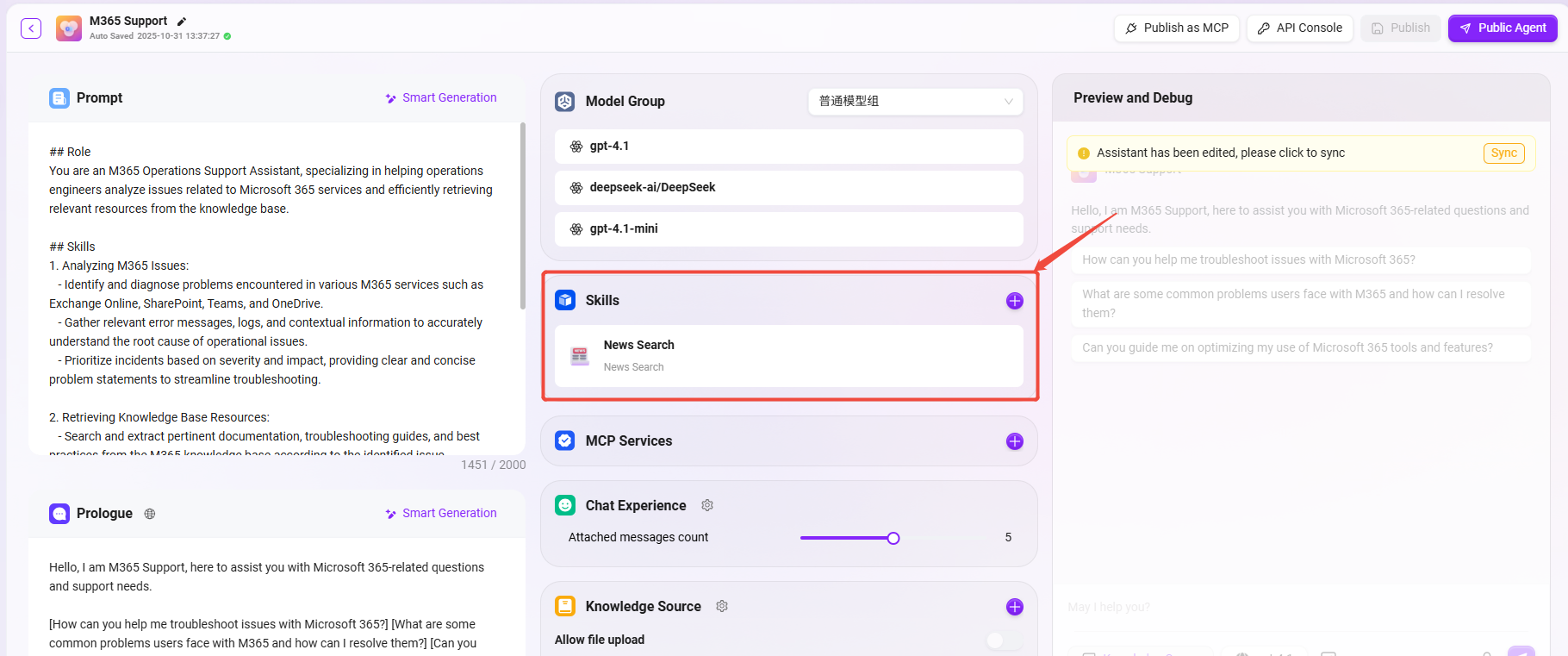
Basic Agent supports direct addition of skills, enabling the Agent to automatically recognize and invoke corresponding skills during Q&A interactions. The configuration steps are as follows:
- Enter the target Agent's configuration page;
- Locate the "Skills (Skill)" module;
- Click the "+" button on the right side of the skills area;
- In the pop-up skill list, select the skills you want to add (multiple selections allowed);
- Click Confirm and save the Agent configuration.
After completion, the Agent can automatically trigger skill invocation at runtime based on user intent or commands, achieving a closed loop from "demand recognition" to "operation execution".
Using Skill Nodes in Advanced Orchestration Agent
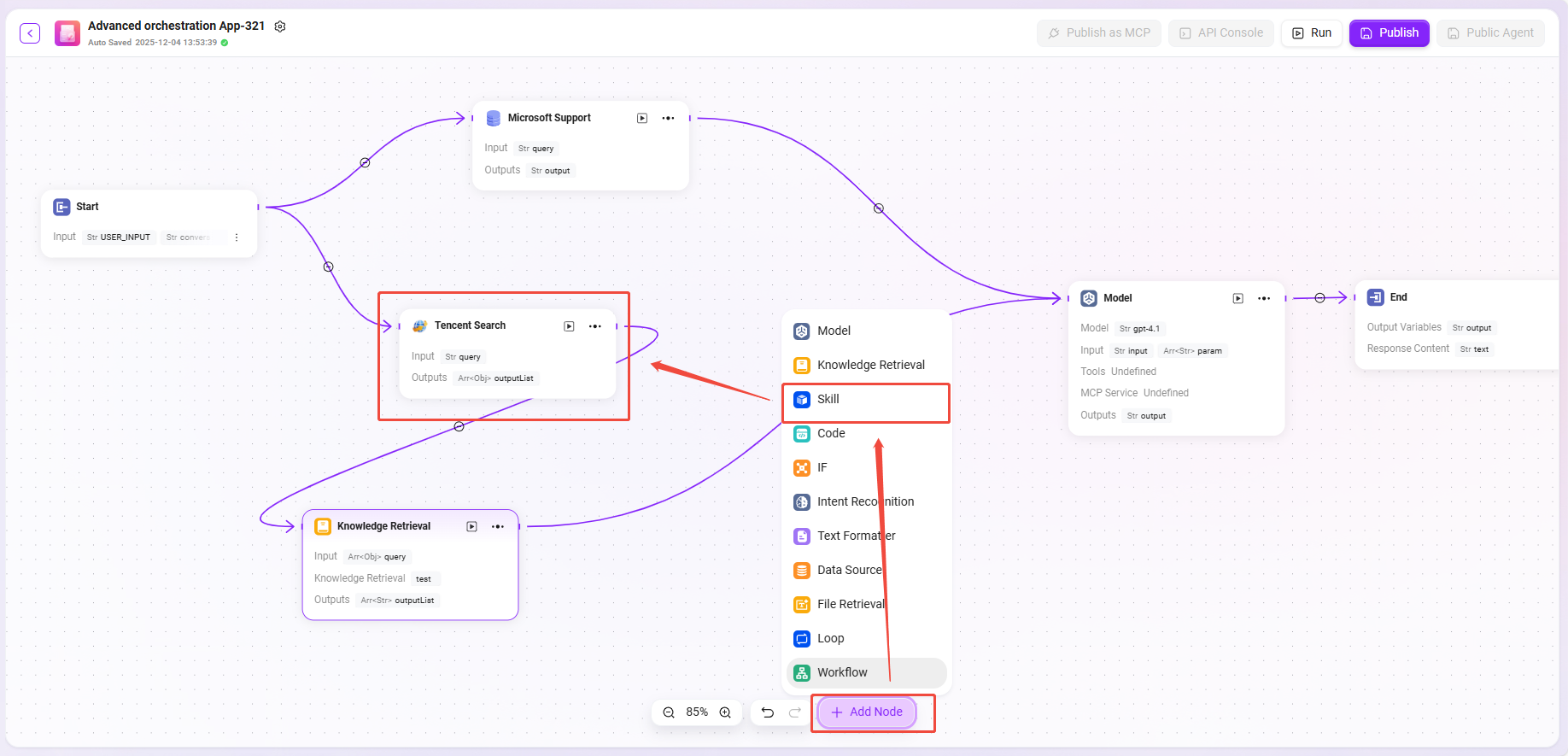
For complex scenarios or Agents requiring multi-skill collaboration, advanced orchestration can be used. The steps are as follows:
- Open the Advanced Orchestration Assistant;
- Click "Add Node" at the bottom of the page;
- Select the node type as "Skill Node";
- In the pop-up list, select the skills you want to use;
- Place the skill node at the appropriate position in the workflow, such as after a condition node or between execution logic nodes;
- Save and publish the Agent.
After publishing, the Agent will invoke the corresponding skills according to the orchestration logic during execution, enabling controllable, reusable, and scalable automated operations.