Super Agent Scenario Use Case
Biopharmaceutical Research Trend Report Generation (Cancer Targeted Drugs)
When many users first encounter Super Agent, what they care about most is not the underlying technical details, but rather: what problems can it actually help me solve, what work can it save me, and what results can it ultimately deliver.
Therefore, the best way to understand it is not to start from a feature list, but to begin with a real work scenario.
In the biopharmaceutical industry, researchers, business teams, marketing teams, or management often need to quickly understand research trends in a specific niche, such as cancer targeted drugs. The traditional approach usually involves multiple steps such as information retrieval, information filtering, trend analysis, structure organization, and content writing. It is time-consuming, costly, and fragmented.
The value of Super Agent lies in this: it integrates these originally fragmented tasks into a complete process that can be initiated directly, executed automatically, and produce deliverable results.
Real Scenario: The User Wants to Quickly Obtain a Trend Report
Suppose a user's current goal is:
I want to quickly understand the research trends in the field of cancer targeted drugs in recent years and produce a report that can be read, shared, or presented.
This goal itself is not complicated, but the traditional execution process often includes the following work:
- Define the research topic and scope
- Search literature, industry materials, and public information
- Extract key conclusions and data points
- Identify technology trends and market directions
- Organize into a structured report
- Prepare it as a PDF or PPT as needed
In other words, what the user truly needs is not a simple Q&A, but a complete task execution capability from “asking a question” to “delivering results.”
How Users Start Using Super Agent
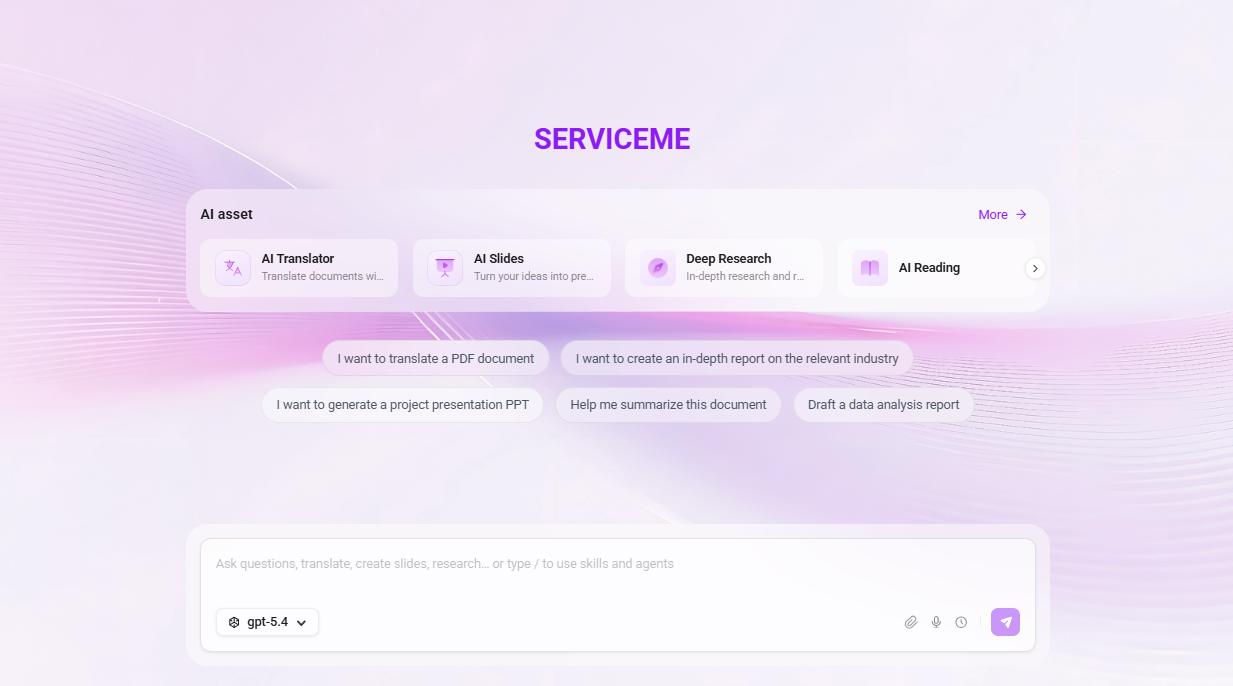
In Super Agent, users do not need to first understand what Agents, Skills, or workflow nodes exist inside the system. They only need to directly state the task.
For example, the user can enter:
Generate a research trend report on cancer targeted drugs.
Or directly use Chinese:
请帮我生成一份关于肿瘤靶向药物的研究趋势报告。
This step reflects the first core value of Super Agent: a unified entry point.
Users do not need to break down the task themselves, nor do they need to choose a combination of tools. They only need to express the goal.
What Super Agent Does After Receiving the Request
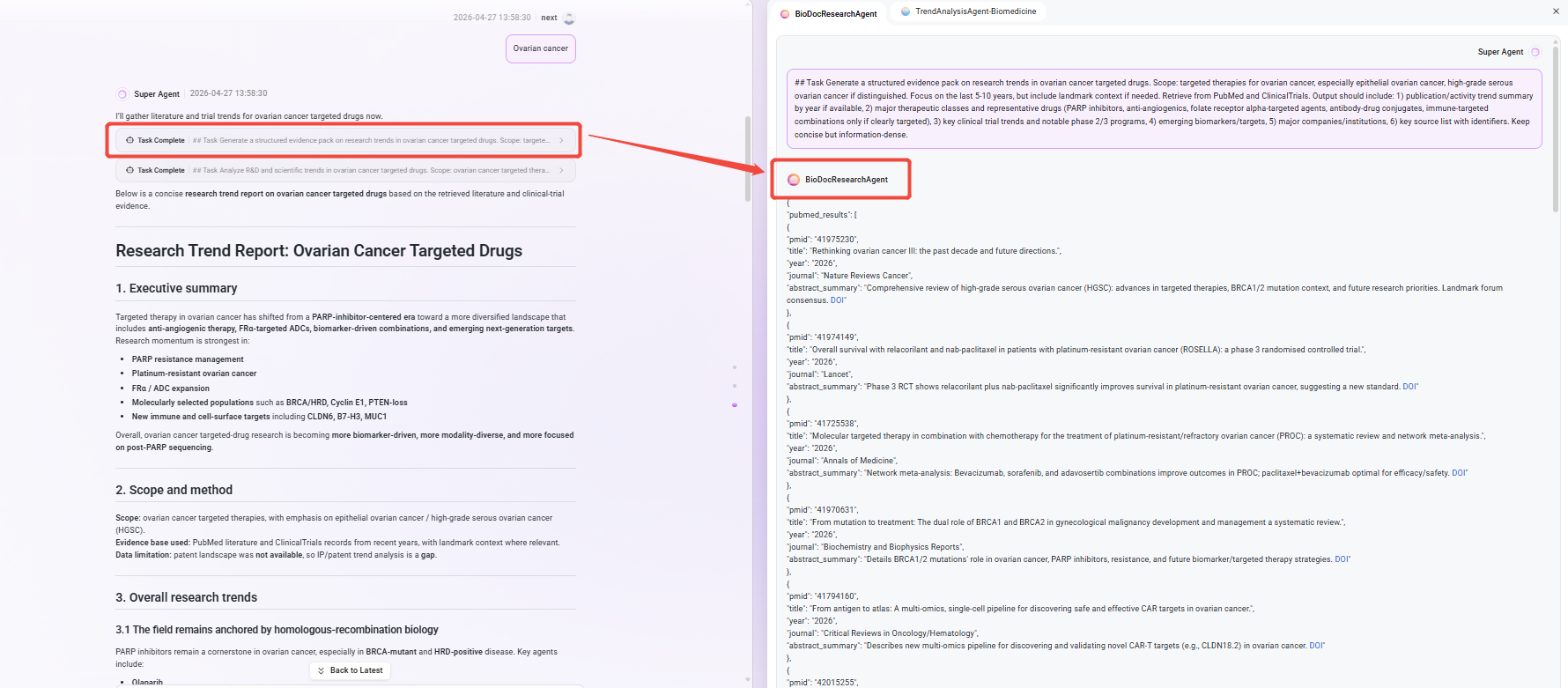
After the user initiates the task, Super Agent does not immediately provide a vague and generic answer. Instead, it first understands the true intent of the task.
In this case, the system will typically identify the following information:
- Task type: research report generation
- Domain: biopharmaceuticals
- Research topic: cancer targeted drugs
- Whether further confirmation of scope and output requirements is needed
Then, the system will automatically match an appropriate Skill, for example:
Skill: biopharma-research (v1.0.0)
Here, Skill can be understood as a professional execution template for a certain type of task. It is not a single capability, but a complete way of organizing tasks.
This step reflects the second core value of Super Agent: automatically understanding the task and finding the most suitable execution path.
Why the System First Confirms Requirements with the User
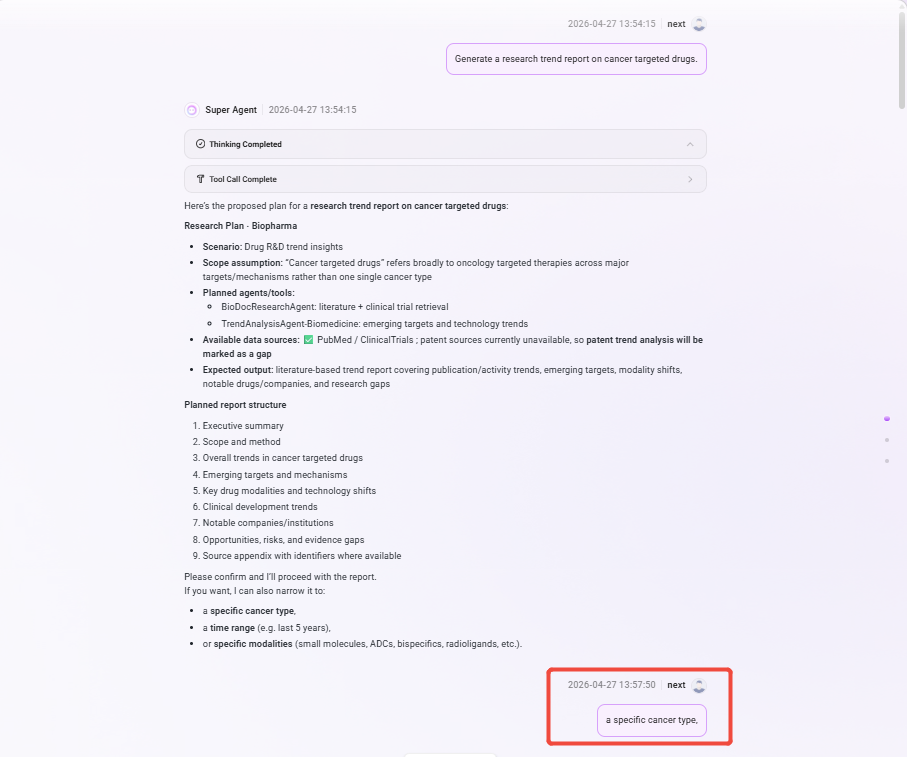
Before formal execution, Super Agent will often conduct a brief confirmation with the user, for example:
- Whether to focus on specific cancer types, such as lung cancer or breast cancer
- Whether the time range is the past 3 years, past 5 years, or longer
- Whether to focus on certain companies, drugs, or technical targets
- Whether the output language should be Chinese or English
- Whether the final output should be text, PDF, PPT, or multiple formats
For example, the system may ask follow-up questions such as:
Do you want to focus on a specific cancer type?
What time range should the report cover?
Do you need a presentation (PPT) as well?
The significance of this step is that Super Agent does not execute mechanically, but clarifies requirements at key points.
The value this brings is:
- Reduce off-topic results
- Improve content relevance
- Lower the cost of later rework
In other words, what Super Agent provides is not “indiscriminate automation,” but “task execution with understanding capability.”
How Skill Breaks Complex Tasks into Multiple Executable Stages
Once requirement confirmation is completed, the Skill begins orchestrating the task.
In this scenario, the Skill’s job is not to complete all content by itself, but to break the complex task into multiple clearer subtasks and coordinate appropriate sub-Agents to execute them collaboratively.
A typical execution flow is as follows:
User submits a research request
↓
Super Agent understands the task
↓
Matches the biopharma-research Skill
↓
Confirms research scope and output requirements
↓
Coordinates multiple sub-Agents
↓
Integrates results and generates the report
↓
Outputs text / PDF / PPT
This step reflects the third core value of Super Agent: automatically breaking down complex tasks into a standardized workflow.
What Multiple Sub-Agents Do in This Scenario
In this case, the system will typically invoke multiple sub-Agents internally to handle different stages of the work.
1)TrendAnalysisAgent-Biomedicine
Main responsibilities:
- Analyze industry development trends
- Extract key technology pathways
- Assess future development directions
- Summarize market changes and hot topics
In the cancer targeted drugs scenario, it may output:
- Evolution path of targeted drug technologies
- Trend changes in popular therapeutic targets, such as EGFR, PD-1, HER2, etc.
- Key directions in clinical research and commercialization
2)BioDocResearchAgent
Main responsibilities:
- Retrieve relevant research literature and public materials
- Summarize reliable data sources
- Extract key research conclusions
- Provide factual support for trend judgments
Typical data sources may include:
- Academic papers
- Industry research reports
- Pharmaceutical databases
- Public corporate materials
3)ReportGeneratorAgent
Main responsibilities:
- Consolidate results from multiple sub-Agents
- Organize content according to a predefined structure
- Generate a structured report that is readable and shareable
4)PDFGeneratorAgent / PPTGeneratorAgent(Optional)
Main responsibilities:
- Further convert the report into formal deliverable materials
- Support downloading, presentation, or external sharing
This complete collaboration mechanism reflects the fourth core value of Super Agent: multi-Agent collaboration rather than a single response.
What the user sees is one entry point, but behind it is actually a professionally divided task execution system.
What Kind of Final Result Will Be Generated
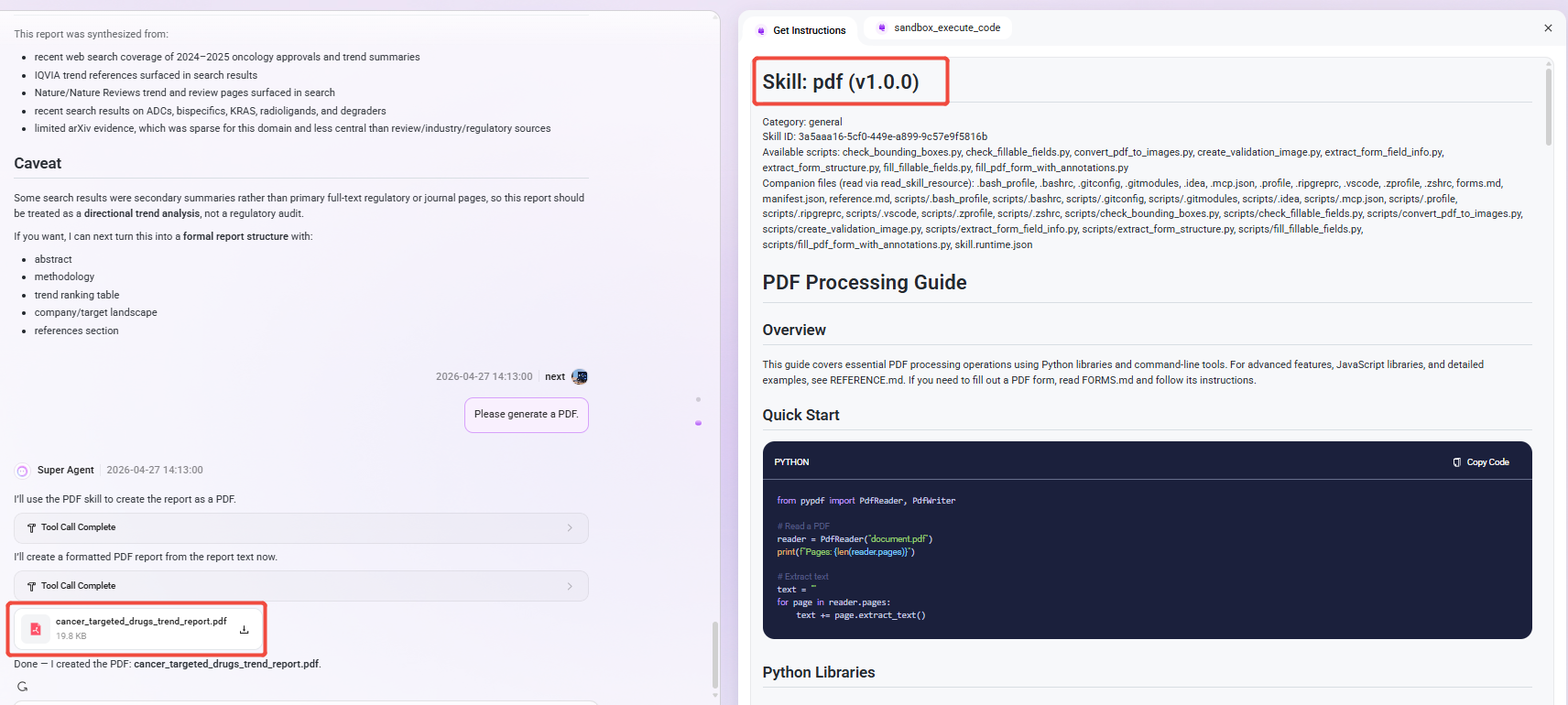
After multiple sub-Agents complete their tasks, the system integrates the results into a structured output.
In this scenario, a typical report structure includes:
- Executive Summary(Summary)
- Industry Overview(Industry Overview)
- Key Players(Key Companies)
- Technology Trends(Technology Trends)
- Market Analysis(Market Analysis)
- Future Outlook(Future Outlook)
This means that what the user receives is not a few scattered paragraphs, but a research deliverable with complete logic and a clear structure.
If the user has further delivery requirements, Super Agent can also output:
- Text report: suitable for quick reading and further editing
- PDF report: suitable for formal sharing and archiving
- PPT presentation materials: suitable for meetings, client presentations, and internal showcases
This step reflects the fifth core value of Super Agent: it not only generates content, but can also directly deliver results.
Understanding the Value of Super Agent in This Scenario in One Sentence
Super Agent does not simply answer a question more completely; it executes a real work task all the way through.
In this biopharmaceutical research scenario, it enables users to start from a single requirement, go through automatic understanding, task orchestration, multi-Agent collaboration, and structured output, and ultimately obtain a report deliverable that can be used directly.
Core Value
- Use natural language as a unified entry point
- Use Skill to organize complex task workflows
- Use multiple Agents to collaboratively complete professional work
- Use structured methods to output directly usable deliverables
Therefore, Super Agent is not just a conversational tool, but a task execution platform capable of handling real business tasks and completing the entire process from input to delivery.